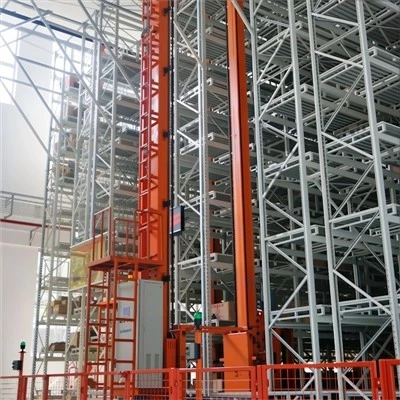
A modern warehouse is no longer simply a place to store products-it is an intelligent operating center where storage, inventory, picking, handling, software, and fulfillment work together.
As supply chains become more complex and customer expectations for faster fulfillment continue to increase, traditional warehouse operations are facing growing pressure. Manual storage, paper-based inventory management, long picking routes, and labor-intensive material handling can make it difficult to maintain both efficiency and accuracy.
Warehouse automation provides a practical way to redesign these processes. By combining automated storage systems, warehouse robotics, conveyors, intelligent picking equipment, and warehouse software, companies can create a more connected and scalable operation.
This guide explains what warehouse automation is, how an automated warehouse works, the main types of warehouse automation systems, key benefits, implementation considerations, and how to select a suitable warehouse automation solution. It also introduces Riches as a professional partner for customized automated warehousing projects.

What Is Warehouse Automation?
Warehouse automation refers to the use of equipment, robotics, software, and control technologies to automate repetitive warehouse activities such as receiving, storage, retrieval, picking, sorting, transportation, and order fulfillment.
It does not necessarily mean eliminating workers from every warehouse process. In many projects, the objective is to allow employees to focus on higher-value activities while automated systems handle repetitive or physically demanding operations.
A typical automated warehouse may integrate:
| Warehouse Function | Common Automation Technology | Main Purpose |
|---|---|---|
| Storage | AS/RS, shuttle systems, automated racks | Increase storage density |
| Material Handling | Conveyors, AGVs, AMRs | Reduce manual transportation |
| Picking | Goods-to-person, robotic picking | Improve picking productivity |
| Sorting | Automated sorters | Speed up order classification |
| Inventory | WMS, RFID, barcode systems | Improve inventory visibility |
| Control | WES/WCS | Coordinate equipment |
| Data Management | WMS and analytics | Support real-time decisions |
The most effective projects do not simply add individual machines. They connect warehouse equipment, software, inventory data, and operational processes into one coordinated system.
Why Are More Warehouses Adopting Automation?
The demand for warehouse automation is closely connected to several operational challenges.
Warehouses with high volumes of repetitive work may require large numbers of operators for storage, picking, transportation, and sorting. Automation can reduce dependence on manual labor for repetitive tasks.
Land and facility costs can make warehouse expansion expensive. High-density automated storage can make better use of vertical space and reduce unnecessary aisles.
E-commerce, omnichannel retail, manufacturing, and 3PL operations often require warehouses to process large numbers of orders within short time windows.
Manual inventory operations can create discrepancies caused by incorrect scanning, misplaced products, or data-entry errors. Integrated warehouse management software can provide better inventory visibility.
Customers increasingly expect shorter delivery times. Warehouse automation can reduce unnecessary movement between storage, picking, packing, and shipping areas.

How Does an Automated Warehouse Work?
Although system designs vary by industry, a typical automated warehouse follows a connected material flow.
Products arrive at the warehouse and are identified through barcodes, RFID, vision systems, or other identification technologies.
The warehouse management system records product information and determines the appropriate storage location.
After receiving, goods can be transported to their designated storage position using conveyors, shuttles, stacker cranes, AGVs, or AMRs.
An Automated Storage and Retrieval System (AS/RS) can automatically place inventory into high-density storage locations.
The WMS maintains information about SKU location, quantity, movement, and order status.
This allows warehouse managers to monitor inventory without relying entirely on manual stock checks.
When an order enters the system, the warehouse software determines which inventory should be retrieved and which equipment should perform the task.
Depending on the warehouse design, products may be delivered to workers through a goods-to-person system, or robots and automated equipment may perform part of the picking process.
Automated sorting systems can direct products to different orders, destinations, or packing stations.
After packing, products are transferred to the outbound area for loading and delivery.
This creates a continuous workflow from receiving → storage → retrieval → picking → sorting → packing → shipping.
Main Types of Warehouse Automation
There is no universal warehouse automation system. The right technology depends on SKU characteristics, throughput, warehouse dimensions, order profiles, and investment objectives.
| Automation Type | Suitable For | Key Advantage |
|---|---|---|
| AS/RS | Pallets, totes, bins | High-density storage |
| Shuttle System | High-volume totes/cases | Flexible high-throughput storage |
| AGV | Repetitive transport | Automated material movement |
| AMR | Dynamic transportation | Flexible warehouse navigation |
| Conveyor System | Fixed material flow | Continuous transportation |
| Automated Sorter | High-volume order processing | Fast sorting |
| Goods-to-Person | Piece picking | Less operator travel |
| Robotic Picking | Repetitive SKU handling | Reduced manual picking |
| WMS | Inventory management | Real-time inventory control |
| WES/WCS | System coordination | Equipment orchestration |
AS/RS: A Core Technology in Warehouse Automation
Among modern warehouse automation technologies, Automated Storage and Retrieval Systems (AS/RS) are particularly important for operations that require high storage density and controlled inventory movement.
An AS/RS typically combines storage structures, automated handling equipment, conveyors, sensors, and software.
Depending on the application, an AS/RS solution can be designed for:
Pallet storage
Tote storage
Bin storage
Small parts
High-density inventory
Manufacturing components
E-commerce fulfillment
Distribution centers
For companies with limited floor space, automated storage can make better use of warehouse height while reducing unnecessary operator travel.
Riches provides AS/RS solutions covering different load units, including pallets, totes, trays, bins, and small parts, while integrating cranes, shuttle robots, AGVs/AMRs, and warehouse software where required.
Warehouse Automation Equipment and Software
Automation works best when physical equipment and software operate as an integrated architecture.
A Warehouse Management System manages inventory, warehouse locations, receiving, putaway, picking, replenishment, and shipping information.
WES can coordinate warehouse activities and balance work between people and automated equipment.
WCS focuses more directly on controlling automated warehouse equipment and coordinating equipment-level movements.
AGVs and AMRs automate material transportation. AMRs can provide greater route flexibility, while AGVs are commonly used for predefined transportation workflows.
Conveyors provide continuous material transportation, while automated sorters direct products to the appropriate destination.
Key Benefits of Warehouse Automation
A properly designed automated warehouse system can deliver improvements across multiple operational areas.
| Benefit | Traditional Challenge | Automation Response |
|---|---|---|
| Higher productivity | Long manual travel routes | Automated transportation |
| Better space utilization | Large aisle requirements | High-density storage |
| Improved accuracy | Manual data entry | Software-controlled processes |
| Faster fulfillment | Slow picking and sorting | Automated workflows |
| Lower labor dependency | Repetitive manual work | Robotics and automation |
| Better visibility | Fragmented inventory records | WMS integration |
| Improved safety | Heavy manual handling | Automated material movement |
| Scalability | Difficult capacity expansion | Modular automation |
However, automation should not be purchased simply because it is technologically advanced. The system needs to solve a measurable operational problem.
How to Choose the Right Warehouse Automation Solution
Before contacting a warehouse automation manufacturer, buyers should define their operational requirements.
Consider:
SKU quantity
Product dimensions
Product weight
Packaging format
Inventory turnover
Storage requirements
Determine how many:
pallets per hour
totes per hour
orders per hour
order lines per hour
the warehouse needs to process.
Warehouse height, floor area, column positions, fire protection, loading areas, and existing racks can all affect automation design.
Not every warehouse needs full automation.
| Automation Level | Typical Application |
|---|---|
| Manual | Low-volume operations |
| Semi-Automated | Growing warehouses |
| Highly Automated | High-volume distribution |
| Fully Integrated | Complex, high-throughput facilities |
A warehouse automation system should ideally accommodate future increases in inventory, order volume, and SKU numbers.
Riches: Customized Warehouse Automation Solutions
Riches is a professional warehouse automation manufacturer and intelligent warehousing solution provider with more than 15 years of digital logistics expertise. Founded in 2008, the company provides warehouse management systems, automated warehouse design, AGV solutions, intelligent sorting systems, data visualization, and on-site implementation services.
Rather than supplying a single piece of equipment, Riches focuses on integrated warehouse solutions covering multiple operational stages.
Riches Warehouse Automation Solutions Include
| Solution | Application |
|---|---|
| Automated Storage | High-density inventory storage |
| AS/RS | Automated storage and retrieval |
| Goods-to-Person | Efficient order preparation |
| Automated Picking | Faster order fulfillment |
| Automated Handling | Internal material movement |
| Robotic Stations | Reduce repetitive operations |
| WMS/WES/WCS | Warehouse software and control |
| Warehouse Revamping | Upgrade existing facilities |
Riches also serves multiple industries, including manufacturing, cross-border e-commerce, FMCG, pharmaceuticals, food and beverage, cosmetics, textiles, and retail.
Its approach combines warehouse planning, equipment selection, system integration, software, implementation, and optimization, allowing customers to develop a warehouse automation project around actual operational requirements rather than buying isolated machines.
The company's website also highlights project results including improvements in inventory turnover, sorting efficiency, distribution timeliness, and warehouse operating accuracy.
For companies upgrading an existing warehouse, Riches also provides warehouse revamping, helping integrate new technologies with existing infrastructure instead of requiring every facility to be rebuilt from scratch.

Warehouse Automation Procurement Checklist
For international buyers, the following information can help a warehouse automation manufacturer develop an accurate proposal.
| Information Required | Example |
|---|---|
| Warehouse size | 5,000–20,000 m² |
| Clear height | 8–30 m |
| SKU quantity | 1,000+ SKUs |
| Load type | Pallet / tote / carton / bin |
| Load weight | kg per unit |
| Daily orders | Orders per day |
| Peak throughput | Orders per hour |
| Storage capacity | Pallet/tote positions |
| Picking method | Person-to-goods / goods-to-person |
| Existing equipment | Racks, conveyors, WMS |
| Expansion plan | 3–5 year capacity |
Providing this information at the quotation stage can help suppliers evaluate equipment configuration, storage capacity, throughput, software integration, and project cost more accurately.
6 Common Questions Buyers Ask Before Purchasing Warehouse Automation
The cost depends on warehouse size, storage capacity, SKU characteristics, throughput, automation level, equipment selection, software integration, and installation requirements. A customized quotation is generally more meaningful than a standard equipment price.
Yes. Small and medium-sized warehouses can use selective automation such as warehouse software, conveyors, AMRs, automated picking, or compact storage systems. The key is selecting automation according to actual throughput and ROI rather than facility size alone.
Warehouse automation is the broader concept covering storage, retrieval, picking, transportation, sorting, software, and robotics. AS/RS is one specific category of warehouse automation focused primarily on automated storage and retrieval.
Yes. Integration is an important part of many warehouse automation projects. The specific interface depends on the existing WMS, WES/WCS architecture, equipment protocols, and data requirements.
Yes. Riches develops customized automated warehousing solutions based on warehouse conditions, storage requirements, throughput, product characteristics, and business objectives. Its capabilities cover warehouse design, automation equipment, software, implementation, and warehouse revamping.
Buyers should provide warehouse dimensions, clear height, SKU data, product dimensions and weights, storage requirements, daily order volume, peak throughput, picking process, existing equipment, and future expansion requirements. These details allow the supplier to design a more suitable warehouse automation solution and provide a more accurate quotation.
Conclusion
Warehouse automation is no longer limited to automated storage equipment. A modern solution can combine AS/RS, warehouse robotics, AGVs, AMRs, conveyors, automated picking, sorting systems, WMS, WES, and WCS to create a connected warehouse operation.
The most important factor is not how much automation a warehouse can install, but whether the selected system matches its inventory profile, throughput, space, labor requirements, and long-term growth strategy.
For companies planning a new automated warehouse or upgrading an existing facility, Riches provides integrated and customized solutions covering storage, goods-to-person operations, picking, handling, robotics, software, and warehouse revamping. With engineering capabilities spanning system design through implementation, Riches can support businesses looking to build a more efficient, accurate, scalable, and intelligent warehouse.