


Types of Warehouse Robots and Their Applications
- Automated Guided Vehicles (AGVs): Designed for repetitive material transport along predefined routes, AGVs move pallets, containers, and production materials between designated warehouse locations with consistent accuracy.
- Autonomous Mobile Robots (AMRs): Use onboard sensors and navigation systems to move through warehouse environments, supporting flexible material transfer and adapting routes to changing operational conditions.
- Pallet Handling Robots: Handle palletized goods between storage areas, loading zones, and production lines. They are suitable for facilities that require frequent movement of heavy loads and standardized pallets.
- Robotic Picking Systems: Assist with item identification, picking, sorting, and order fulfillment. These systems help improve picking consistency and support warehouses processing large numbers of individual orders.
- Robotic Forklifts: Automate pallet lifting, stacking, and transportation across warehouse aisles. They can reduce manual forklift operations and support more consistent material handling in high-volume facilities.
- Collaborative Robots (Cobots): Work alongside warehouse personnel on tasks such as order picking, packing, and goods handling. Their deployment can help reduce repetitive manual work and improve workstation productivity.
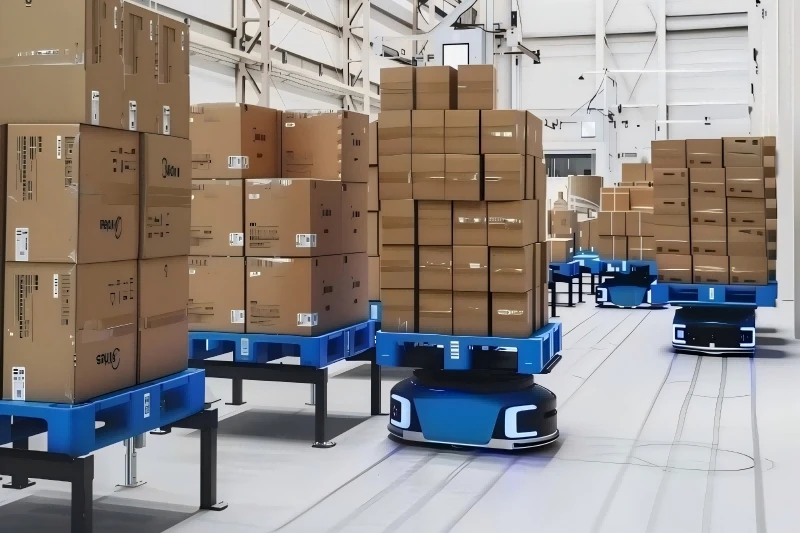
Pallet AGV Technical Specifications
| Item | Specification |
| Overall Dimensions (L × W × H) | 1090 × 830 × 275 mm |
| Net Weight | 162 kg |
| Max. Load Capacity | 1000 kg |
| Max. Lifting Height | 60 mm |
| Min. Lifting Time | 4 s |
| Max. Travel Speed | 2 m/s (unladen); 1.6 m/s (fully loaded) |
| Max. Rotation Speed | 90° / 1.5 s; 180° / 2 s |
| Max. Gradeability | 2.5° (4.4% slope) |
| Stopping Accuracy | < ±10 mm |
| Drive System | Dual-wheel differential drive |
| Navigation | Inertial + QR-code visual navigation |
| Charging Method | Automatic charging |
| Operating Time | 10 min charge → 1 h operation *Charge time and runtime are user-configurable |
| Communication | Wi-Fi, dual-band 2.4 GHz / 5 GHz, IEEE 802.11 b/g/n |
| Obstacle Detection Range | 2 m (infrared) / 3 m (LiDAR) |
| Audible & Visual Alarm | Supported |
| Emergency Stop | Supported, one on the front and one on the rear panel |
Why Choose Riches for Warehouse Automation Solutions?
- Integrated System Planning: Riches develops warehouse storage and logistics solutions based on facility layout, inventory characteristics, material flow, and operational requirements, helping customers establish a coordinated warehouse system.
- Experience in Warehouse Engineering: We provide solutions covering automated storage and retrieval systems, pallet shuttle systems, warehouse racking, and material handling equipment to meet different storage and throughput requirements.
- Application-Specific Configuration: We evaluate load capacity, storage density, picking processes, and equipment coordination to recommend configurations suited to each warehouse project rather than relying on a standard setup.
- Long-Term Operational Support: We consider equipment accessibility, maintenance requirements, and future expansion during the planning stage, helping customers maintain stable operations as storage demands change.
- Project-Oriented Service: From initial requirement assessment and solution design to equipment coordination and implementation support, we work with customers to align the warehouse system with their operational objectives.
Everything You Need to Know
Q1: What factors should be considered when selecting a robotic warehouse automation system?
A: Key factors include payload capacity, travel distance, aisle width, floor conditions, task frequency, and the type of goods being handled. At Riches, we consider these operating conditions when evaluating suitable robotic equipment and its integration with the overall warehouse layout.
Q2: Can robotic warehouse automation handle different pallet sizes and load weights?
A: Yes, robotic material handling systems can be configured for different pallet dimensions and load requirements, depending on the selected equipment. Riches assesses pallet specifications, load stability, lifting height, and transfer requirements to help determine the appropriate handling configuration.
Q3: How do warehouse robots coordinate tasks during peak operating periods?
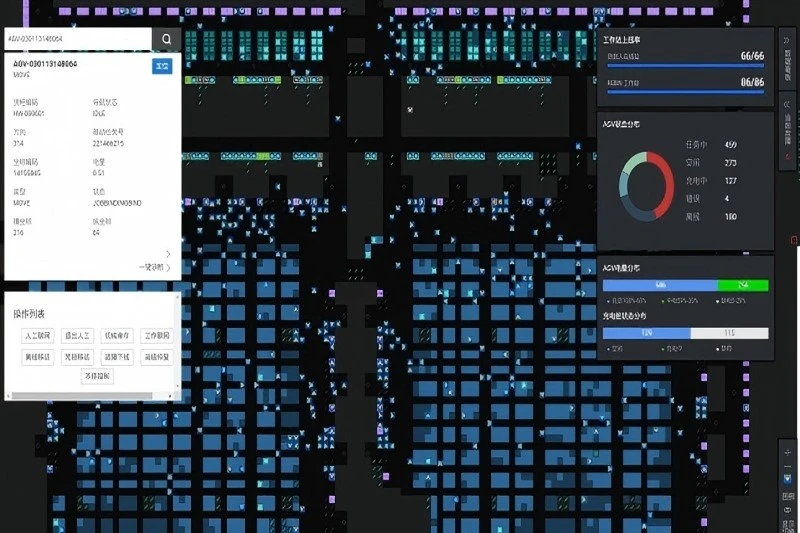
A: Robot fleet management systems can assign transport tasks, prioritize movements, and coordinate routes to reduce unnecessary travel and traffic conflicts. The actual performance depends on fleet capacity, dispatching logic, warehouse traffic, and the efficiency of the supporting control system.
Q4: What infrastructure is required before installing warehouse robots?
A: Installation requirements may include suitable floor conditions, charging stations, safety zones, network coverage, designated travel paths, and interfaces with existing warehouse systems. Riches can evaluate these site-specific factors during solution planning to identify infrastructure adjustments before deployment.
Q5: Can a robotic warehouse automation system be expanded as business demand grows?
A: Expansion depends on the original system architecture, available floor space, software capacity, and compatibility between equipment. Riches considers potential increases in storage volume and material handling demand during project planning, helping customers assess future options for adding robots, storage equipment, or handling stations.
Hot Tags: robotic warehouse automation, China robotic warehouse automation manufacturers, suppliers


