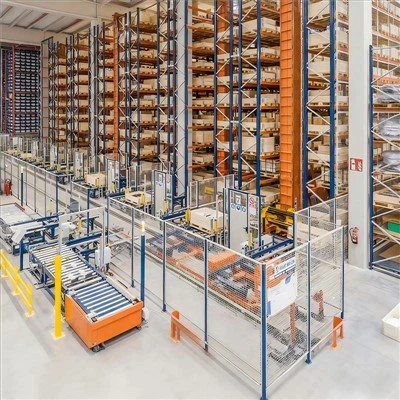
Warehouse order picking systems are optimized protocols and innovative technologies for swiftly collecting products to fulfill customer orders, ranging from straightforward manual modes such as Cluster Picking and Parallel Picking to state-of-the-art automated setups featuring ASRS for goods storage and retrieval, Voice Picking systems for hands-free operation, and AMRs for flexible transportation, all targeted at lowering error rates and accelerating order processing in modern warehousing.

Common Picking Methods
(Manual & Semi-Automated)
Single Order Picking
A picker completes the full assembly of one order in its entirety before commencing work on the next order; ideal for small-scale warehouses with low order volumes.
Batch Picking
A picker collects required items for multiple orders in a single warehouse trip, with the sorted allocation of goods to respective orders taking place at a dedicated packing station afterward.
Zone Picking
Pickers are assigned to fixed warehouse zones and only handle order lines within their designated areas, with order totes being passed between zones in a sequential "pick and pass" workflow.
Cluster Picking
Pickers utilize carts equipped with multiple bins to pick items for several orders at the same time, sorting the goods into the corresponding bins for each order during the picking process.
Wave Picking
Orders are grouped into discrete "waves" based on criteria such as shipping deadlines or delivery regions, and this method often integrates batch or zone picking to maximize efficiency in large-scale warehousing operations.
Parallel Picking
Multiple pickers concurrently handle different components of a single complex order across separate warehouse zones, which shortens the overall picking time for high-sku orders.

Key Technologies & Automation
●ASRS (Automated Storage & Retrieval Systems):
Computer-controlled systems (like vertical lifts or shuttle-based) that store and retrieve items, bringing them to pickers (Goods-to-Person).
●AMRs & AGVs (Autonomous Mobile/Guided Vehicles):
Robots that transport items or empty carts to workers, reducing travel time.
●Pick-to-Light/Put-to-Light:
Lights direct pickers to the exact location and quantity of items to pick or place.
●Voice Picking:
Workers wear headsets and receive instructions via voice, confirming picks verbally, keeping hands and eyes free.
●Robotics:
Cobots (collaborative) and independent robots that can pick items from bins, improving speed and accuracy.
FAQ
How do I choose the right picking method (e.g., Single Order/Batch/Zone Picking) for my warehouse?
The selection depends on three core factors: warehouse size (Single Order Picking is ideal for small warehouses; Zone/Wave Picking suits large-scale facilities), order characteristics (Batch Picking works best for orders with high SKU overlap; Parallel Picking is for complex, high-value orders), and product attributes (Cluster Picking fits small, dense items; zone collaboration is for bulky goods). We offer free warehouse diagnostics and customized recommendations based on your daily order volume and SKU count.
What is the typical ROI period for automated picking systems like ASRS and AMRs?
The standard ROI cycle ranges from 1 to 3 years. Initial investments cover equipment procurement, installation, commissioning, and training. Returns come from reduced labor costs (cutting 30%–70% of picking staff), improved efficiency (2–3 times faster picking speed), and lower error rates (dropping from 1% in manual operations to below 0.1%). For warehouses with over 500 daily orders and high labor costs, the ROI can be shortened to within 1 year.
How long does it take for employees to master the system after launch?
Manual and semi-automated models (e.g., Pick-to-Light) require only 1–2 days of training for proficiency, as core operations are simple and intuitive. Automated equipment (e.g., AMRs, voice picking) needs 3–5 days of training, covering device operation and basic troubleshooting. We provide standardized training manuals and one-on-one guidance to ensure quick adaptation and minimize the impact of staff turnover.
Can the system handle order volume fluctuations, such as e-commerce peak seasons and holiday surges?
Absolutely. The system supports a combined solution of "wave picking + flexible capacity expansion". It can quickly adjust wave picking grouping based on order peaks, and integrate AMR robots and temporary zoning to allocate resources dynamically. This ensures stable order fulfillment efficiency even when order volumes surge 3–5 times, avoiding delays and backlogs.
Is the warehouse order picking system compatible with our existing WMS or ERP software?
Yes. Our system features open APIs and supports seamless integration with mainstream WMS, ERP, and TMS platforms on the market. It can achieve real-time data synchronization, including order download, inventory update, and picking status tracking. Our technical team will provide full-process integration support to ensure zero disruption to your existing business workflows.
What after-sales support is provided for the system?
We offer a comprehensive after-sales service package: 24/7 remote technical support for troubleshooting, on-site maintenance within 48 hours for equipment failures, annual system upgrades and optimization, and regular operator retraining. We also provide a 1-year warranty for core components, ensuring long-term, stable operation of your picking system.
Hot Tags: warehouse order picking systems, China warehouse order picking systems manufacturers, suppliers, automated picking, robotic order picking, warehouse order picking systems, automated warehouse order picking, automated picking systems in warehouse , order picking system