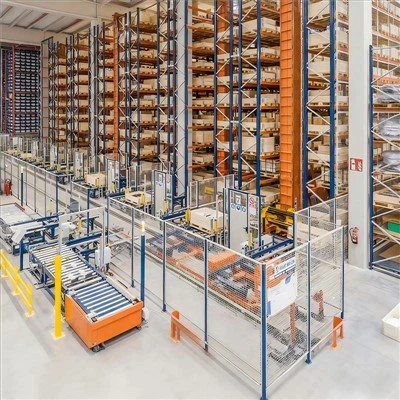
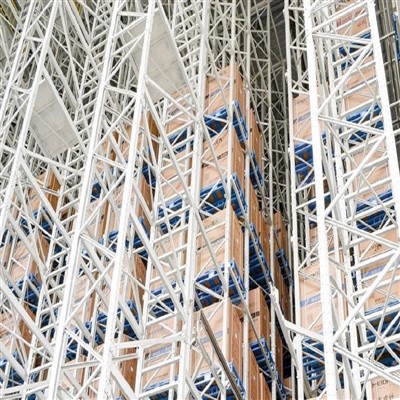
Semi-Automated Material Handling Systems are integrated solutions that combine automated technology with human labor. Machines handle repetitive, predictable tasks, and workers focus on complex, value-adding activities. Unlike full automation, SAMHS allows customization-businesses can choose which warehouse operations to automate, from basic goods movement to high-density storage, adapting to workflow needs, budget constraints, and growth plans.
Core technologies include conveyors, automated storage & retrieval modules, voice-guided picking tools, and pallet shuttles, which automate time-consuming tasks like product transport, storage, and sorting. Human workers are responsible for quality control, complex order picking, problem-solving, and system supervision.

How They Work And Advantage
●Human-Machine Collaboration
Machines: Handle predictable, repetitive tasks such as moving pallets, transporting cartons, retrieving items from storage, and sorting products.
Humans: Focus on complex activities requiring judgment, dexterity, and decision-making, including complex order picking, quality inspections, exception handling, and system oversight.
●Layered Automation
Businesses can start with partial automation and scale gradually. They can automate a single process or integrate multiple semi-automated modules, adapting to needs without full warehouse overhauls.
1
Faster throughput, reduced labor dependency.
2
Lower investment than full automation; long-term savings from fewer errors and reduced manual labor; faster ROI.
3
Adaptable to changing demands; easier to implement and expand than full automation.
4
Automated precision reduces mistakes and operational risks.
Best For
Businesses bridging the gap between traditional manual warehouses and fully automated facilities.
Operations balancing technology investment with human workforce needs.
Companies seeking increased storage density and throughput without complete warehouse overhauls.
Businesses unable to retain or attract employees.
Operations experiencing excessive errors.
Businesses struggling to meet demand.
Companies aiming to improve competitiveness.
Operations concerned about employee or product safety.
Everything You Need to Know
Cooperate with Riches to improve your warehousing efficiency - automated warehouse solutions!
Q: What is the main difference between semi-automated and fully automated material handling systems?
A: The core difference lies in investment scale, flexibility, and human involvement. Semi-automated systems combine automated machinery with human labor-machines handle repetitive tasks (e.g., transport, storage), while humans manage complex work (e.g., quality checks, exception handling). They require lower initial investment, offer customizable automation ranges, and support gradual scaling. Fully automated systems rely almost entirely on technology with minimal human intervention, requiring higher upfront costs and being less adaptable to dynamic demand changes.
Q: How long does it take to implement a semi-automated material handling system, and will it disrupt daily operations?
A: Implementation timelines vary by project scope-basic configurations (e.g., single conveyor line or pick-to-light system) take 4-8 weeks, while integrated multi-component systems take 3-6 months. REB adopts phased implementation to minimize disruption: we first deploy non-critical modules, conduct staff training in parallel, and then transition to core workflow integration, ensuring daily operations remain unaffected during the process.
Q: Can semi-automated systems be integrated with our existing warehouse equipment
A: Yes. Most semi-automated components are designed for compatibility with standard warehouse equipment. For example, pick-to-light systems can be mounted on existing racking; pallet runners work with conventional lift trucks; conveyors can connect to your current storage and packing zones. REB's team will assess your existing equipment during the design phase to ensure seamless integration without requiring full facility overhauls.h mixed SKUs, moderate throughput requirements, and space constraints-such as distribution centers, e-commerce fulfillment facilities, manufacturing buffer zones, and cold storage environments.
Q: Are semi-automated systems suitable for small to medium-sized businesses (SMBs) with limited budgets?
A: Yes. Semi-automated systems are ideal for SMBs due to their modularity and cost-effectiveness. You can start with a single high-impact component (e.g., a conveyor line to reduce transport labor or a pick-to-light system to cut errors) and expand gradually as your business grows. The lower initial investment (compared to full automation) and ability to customize automation scope based on budget constraints make semi-automation a practical upgrade for SMBs seeking efficiency gains without financial strain.
Hot Tags: semi-automated material handling systems, China semi-automated material handling systems manufacturers, suppliers, modular semi automated smt storage , Automated Warehouses for Intensive Storage, semi automated warehouse, Semi Automated Warehouse Solution, wholesale semi automated storage , Semi Automated Storage Systems