The right warehouse racking system should not simply store more goods. It should make better use of space, support safe material handling, improve inventory flow, and leave room for future growth.
Choosing a warehouse racking system is an important decision for manufacturers, distributors, logistics centers, and fulfillment operations. A rack may look like a simple storage structure, but the wrong configuration can create wasted floor space, difficult picking routes, limited forklift access, and unnecessary expansion costs.
For buyers, the goal is therefore not to find the cheapest warehouse rack. It is to select a storage solution that matches the warehouse layout, inventory characteristics, load requirements, handling equipment, throughput, and long-term operating plans.
Riches approaches warehouse storage from this broader perspective. As a warehouse storage and logistics solution provider, Riches can combine warehouse racking, high-density storage, material handling equipment, and automated warehousing technologies into a coordinated solution rather than treating each rack as an isolated product.

Warehouse Racking System Buyer Requirement Form
Before selecting a warehouse racking system, buyers can prepare the following information for a supplier or warehouse engineer:
| Requirement | Information to Prepare |
|---|---|
| Warehouse Size | Length, width, clear height and usable floor area |
| Product Type | Pallets, cartons, totes, bins, long goods or mixed inventory |
| Load Requirement | Weight per pallet, rack level and bay |
| SKU Profile | Number of SKUs, inventory quantity and product dimensions |
| Inventory Rotation | FIFO, LIFO or mixed requirements |
| Handling Equipment | Forklift, reach truck, stacker, shuttle or AGV/AMR |
| Storage Density | Required storage positions and target capacity |
| Throughput | Inbound, picking and outbound volume |
| Automation | Manual, semi-automated or automated operation |
| Future Growth | Expected increase in inventory and throughput |
| Project Location | Country, warehouse conditions and installation requirements |
Providing these details early allows the supplier to recommend a warehouse racking system based on actual operating requirements instead of relying on a standard configuration.
Start With Your Warehouse Dimensions
The first consideration is the physical warehouse.
Measure more than the floor area. Buyers should evaluate clear ceiling height, column positions, door locations, fire protection equipment, loading docks, emergency exits, floor conditions, and forklift operating zones.
Vertical space is particularly important. A warehouse with limited floor area may still have substantial unused capacity above the existing storage level. High-bay pallet racking, mezzanine systems, and automated storage solutions can make better use of this vertical volume.
However, maximizing height does not always mean installing the tallest possible rack. The final height must work with building restrictions, material handling equipment, fire safety requirements, and operational accessibility.
Calculate Load Capacity Before Choosing the Rack
Load capacity is one of the most important technical factors in warehouse racking systems.
Buyers should provide the actual weight and dimensions of stored products rather than estimating an average load. The supplier needs to understand pallet weight, pallet dimensions, rack beam levels, number of pallets per bay, and the expected load distribution.
For example, a warehouse storing heavy industrial components requires a different rack configuration from an e-commerce facility handling lightweight cartons.
The rack should also account for operating conditions. Repeated forklift movement, uneven loading, pallet variations, and accidental impacts can affect the long-term performance of a storage structure.
A professional warehouse racking manufacturer should therefore calculate the structure according to the intended application rather than simply offering a standard rack size.
Match the Racking Type to Inventory Flow
There is no single best pallet racking system for every warehouse.
Selective pallet racking is suitable when direct access to individual pallets is important. It provides flexible SKU management and works well for warehouses with many different products and relatively frequent inventory movement.
Double-deep pallet racking places storage positions behind one another to reduce the number of aisles. It can increase storage density, although specialized handling equipment may be required to access deeper pallet positions.
Drive-in racking is designed for high-density storage where the number of SKUs is relatively limited and large quantities of similar products need to be stored together.
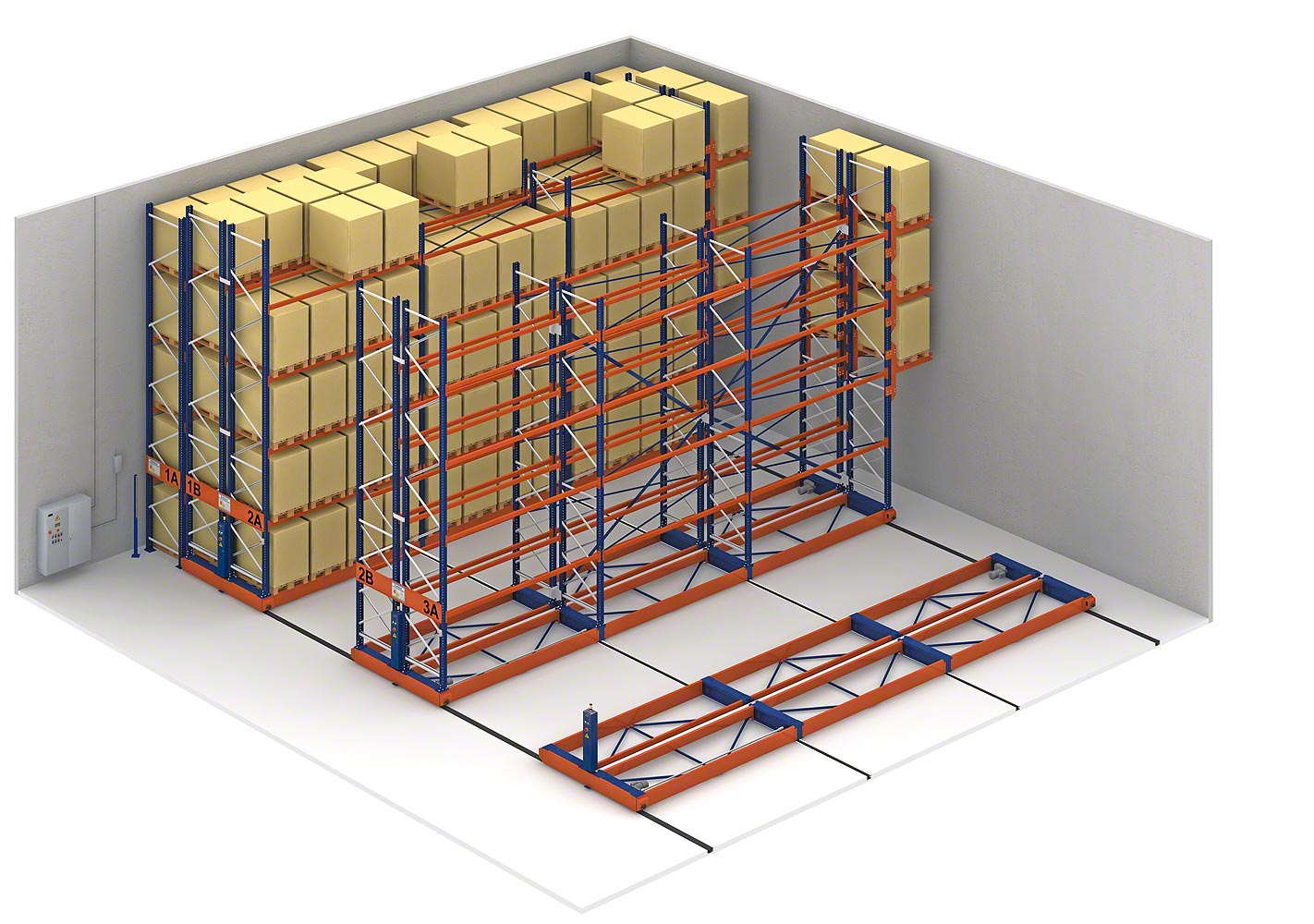
Push-back systems use inclined rails or carts to store multiple pallets in depth. They provide higher density than conventional selective racking and can reduce aisle requirements.
Pallet flow systems use gravity-driven movement and are particularly useful when FIFO inventory rotation is important. They can separate loading and picking activities and support efficient product movement.
For warehouses that need both storage density and higher throughput, pallet shuttle systems provide an alternative to conventional manual pallet handling. Shuttles move pallets within storage lanes, reducing forklift travel inside the rack.
The right choice depends on SKU quantity, inventory turnover, storage density, available equipment, and workflow.
Consider Storage Density vs. Accessibility
One of the most common mistakes when purchasing industrial racking systems is focusing only on maximum storage capacity.
More pallet positions do not automatically mean a more efficient warehouse.
A dense system may reduce aisles and increase capacity, but it can also affect pallet accessibility. A selective system may provide excellent access but require more floor space.
Buyers should determine which is more important for their operation:
Maximum pallet positions
Direct access to every SKU
Faster picking
FIFO rotation
Reduced forklift travel
Lower floor-space requirements
Higher future scalability
The best warehouse storage system balances density and accessibility according to the warehouse's actual operating model.

Check Compatibility With Material Handling Equipment
Warehouse racking should be designed together with material handling equipment.
Forklifts, reach trucks, stacker cranes, pallet shuttles, conveyors, AGVs, and AMRs all have different operating requirements. A rack aisle that works for one forklift may not be suitable for another.
Before ordering a rack, buyers should confirm:
Required aisle width
Maximum lifting height
Pallet entry direction
Fork length
Turning radius
Rack beam height
Equipment operating speed
Loading and unloading workflow
For automated warehouses, the rack becomes part of a larger system. Its dimensions, tolerances, pallet positions, and structural configuration may need to match automated equipment and warehouse control software.
Plan for Safety and Rack Protection
Safety should be considered during system design, not after installation.
Rack protection may include column guards, end-of-row protection, guardrails, safety barriers, pallet supports, and other protective components. These features help reduce the consequences of forklift impacts and daily handling operations.
The warehouse environment should also be evaluated for lighting, pedestrian traffic, emergency access, fire protection, and inspection requirements.
Regular inspection is equally important. A damaged upright, beam, connector, or protective component should not be ignored simply because the rack is still in use.
For buyers, a reliable supplier should be able to explain the safety considerations behind the proposed warehouse racking design rather than focusing only on price.
Decide Whether Automation Is Necessary
Warehouse automation should be considered according to operational requirements rather than treated as a trend.
For warehouses with high throughput, limited labor availability, high storage density requirements, or strict inventory accuracy targets, automated storage can significantly change the way goods move through the facility.
Riches provides solutions that can integrate warehouse racking with AS/RS, shuttle systems, AGVs/AMRs, conveyors, and warehouse software. Its AS/RS solutions can support pallets, totes, trays, bins, and other storage units while connecting with WMS, WES, and WCS systems.
This approach allows the storage structure and material handling process to be planned as one system instead of installing automation after the warehouse racking has already been fixed.
Think About Future Expansion
A warehouse racking system is usually a long-term investment.
Inventory volume, SKU numbers, order frequency, and automation requirements may change over time. A system that meets today's requirements but cannot be expanded may become expensive to replace later.
When comparing suppliers, buyers should ask:
Can additional rack bays be added?
Can beam levels be adjusted?
Can the system support future automation?
Can conveyors or shuttle systems be integrated later?
Can the layout accommodate increased inventory?
Are spare components and technical support available?
Scalability is especially important for growing distribution centers and e-commerce operations.
Compare Suppliers by Engineering Capability
Price is important, but it should not be the only purchasing criterion.
A complete warehouse racking project may involve warehouse measurement, storage analysis, rack configuration, structural calculations, equipment matching, manufacturing, installation, commissioning, and after-sales support.
This is where the difference between a rack supplier and a warehouse solution provider becomes important.
Riches focuses on customized warehouse storage solutions rather than supplying isolated rack components. Its capabilities cover warehouse planning, racking systems, high-density storage, and automated warehousing, allowing buyers to develop a solution around their actual workflow.
For projects involving AS/RS, pallet shuttles, AGVs/AMRs, conveyors, or WMS integration, this integrated approach can also reduce compatibility problems between different equipment suppliers.
Evaluate the Total Cost of Ownership
The purchase price of warehouse racking is only one part of the investment.
Buyers should consider:
| Cost Factor | What to Evaluate |
|---|---|
| Rack Cost | Structure, beams, uprights and accessories |
| Installation | Labor, equipment and project complexity |
| Handling | Forklift or automation requirements |
| Floor Space | Cost of additional warehouse area |
| Maintenance | Inspection, replacement and repair |
| Labor | Picking, putaway and material movement |
| Energy | Especially important for automated systems |
| Expansion | Cost of future capacity increases |
A higher-density or automated system may have a higher initial investment but deliver better long-term utilization and operating efficiency.
Why Choose Riches for Warehouse Racking Systems?
Riches is positioned as a comprehensive warehouse and logistics solution provider for industrial customers. Rather than treating warehouse racking as an individual product, Riches combines storage structures with warehouse planning, high-density storage, material handling, and automation.
Its solution range can cover pallet racking, high-density storage, mezzanine systems, pallet shuttle solutions, AS/RS, AGVs/AMRs, and related warehouse technologies.
For buyers, this means the project can be evaluated from several dimensions at the same time:
Warehouse space utilization
Storage density
Inventory accessibility
Material handling efficiency
Automation compatibility
Future expansion
Overall project cost
This system-level approach is particularly useful for manufacturing plants, distribution centers, e-commerce warehouses, and other facilities where storage capacity and material flow directly affect operating efficiency.
6 Frequently Asked Questions About Warehouse Racking Systems
Start with warehouse dimensions, pallet size, load weight, SKU quantity, inventory turnover, required storage density, handling equipment, and workflow. The best warehouse racking system is the one that matches these operating conditions rather than simply providing the highest number of pallet positions.
Selective pallet racking is widely used because it provides direct access to individual pallets and can accommodate many SKU types. However, high-density systems such as push-back, drive-in, pallet flow, and shuttle racking may be more suitable when storage density or throughput is the primary objective.
There is no universal load rating. Capacity depends on upright design, beam dimensions, rack height, bay width, pallet configuration, material characteristics, and load distribution. Buyers should provide accurate product and pallet weights so the supplier can determine the appropriate rack specification.
Yes. Warehouse racking can be designed for integration with AS/RS, pallet shuttles, conveyors, AGVs, and AMRs. For automated applications, rack dimensions, tolerances, load positions, and structural requirements need to be coordinated with the selected automation equipment.
Choose based on inventory characteristics. Selective racking is generally preferable when direct pallet access and SKU flexibility are important. High-density storage is more attractive when warehouse space is limited and many pallets of similar products need to be stored efficiently.
Yes. Riches develops customized warehouse storage solutions based on warehouse dimensions, product characteristics, load requirements, storage density, material handling processes, and automation needs. For larger projects, the racking system can also be planned together with AS/RS and other warehouse automation technologies.
Conclusion
Choosing warehouse racking systems is not simply a matter of selecting beams, uprights, and shelves. The right solution should connect warehouse space, inventory characteristics, load capacity, accessibility, material handling, safety, automation, and future expansion into one practical operating system.
For a small warehouse, selective pallet racking may provide the flexibility required. For a high-density facility, push-back, pallet flow, shuttle, or other advanced systems may provide better utilization. For high-throughput operations, integrating warehouse racking with AS/RS and automated material handling can take the solution further.
The most effective purchasing process starts with the warehouse itself. Define the operational requirements first, then compare racking configurations and suppliers based on engineering capability, scalability, safety, and total cost of ownership.
For businesses planning a new warehouse or upgrading an existing facility, Riches can provide customized warehouse racking and intelligent warehousing solutions designed around actual storage and material flow requirements.