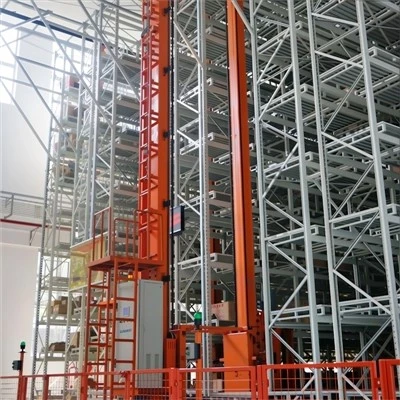
Smart warehouses are advanced facilities that use automation, real-time data, and intelligent systems to manage inventory and optimize operations, reducing human intervention while improving speed, accuracy, and efficiency in logistics workflows.
In today's rapidly evolving supply chain environment, distribution networks are under increasing pressure to deliver faster, more accurately, and at lower cost. Traditional warehouse models-once dependent on manual labor and isolated systems-are no longer sufficient to meet global e-commerce demand, omnichannel fulfillment requirements, and real-time inventory expectations.As a result, smart warehouses have become the foundation of next-generation logistics transformation.

Smart Warehouse System Structure Overview
A smart warehouse is built on an interconnected architecture that integrates hardware, software, and data intelligence into a unified logistics ecosystem.
The central control layer is the Warehouse Management System (WMS), which coordinates inventory, orders, and operational workflows. It connects with enterprise systems and ensures full visibility across the supply chain.
Automated Storage and Retrieval Systems (AS/RS) form the backbone of physical automation. These systems maximize vertical space utilization while enabling fast and precise goods handling through stacker cranes, shuttle systems, and intelligent shelving structures.
Robotic systems such as Autonomous Mobile Robots (AMRs) and Automated Guided Vehicles (AGVs) handle internal transportation tasks. They reduce manual labor dependency while improving operational flexibility and safety.
IoT sensors and RFID technologies provide real-time tracking of inventory, equipment status, and environmental conditions. This ensures full transparency and reduces errors in stock management.
Artificial intelligence and machine learning engines analyze operational data to optimize demand forecasting, inventory distribution, and warehouse performance efficiency.
Together, these components form the foundation of Riches intelligent warehouse solutions, enabling fully integrated and scalable distribution networks.
Understanding Smart Warehouses in Modern Logistics
A smart warehouse is a digitally connected logistics facility that uses automation, robotics, and data intelligence to optimize warehouse operations from inbound receiving to outbound distribution.
Unlike traditional warehouses, smart systems operate in real time, enabling continuous synchronization of inventory, orders, and logistics flows.
This transformation is driven by global supply chain complexity, rising labor costs, and increasing demand for faster fulfillment cycles.
Smart warehousing is no longer a future concept but a current necessity for businesses aiming to remain competitive in global distribution markets.
Core Technologies Behind Smart Warehousing
Automated Storage and Retrieval Systems enable high-density storage while minimizing retrieval time. These systems significantly improve warehouse space utilization and operational accuracy, especially in large-scale distribution centers.
Autonomous Mobile Robots navigate warehouse environments using sensors and AI-based navigation systems. They automate material movement between storage zones, picking stations, and packaging areas, improving workflow efficiency.
IoT and RFID tracking systems provide real-time visibility into inventory location, movement, and condition. This eliminates blind spots in traditional warehouse operations and enhances supply chain transparency.
Artificial intelligence plays a critical role in demand prediction, route optimization, and workload balancing. By analyzing historical and real-time data, AI helps reduce operational inefficiencies and improve decision-making accuracy.
Warehouse Management Systems serve as the digital backbone of smart warehouses, integrating all operational layers into a centralized platform that ensures coordination and control across the entire facility.
Riches integrates all these technologies into unified warehouse ecosystems designed for global-scale logistics operations.
Transformation of Distribution Networks Through Smart Warehousing
Distribution networks are shifting from traditional linear models to dynamic, multi-node logistics ecosystems.
Instead of relying on a single centralized warehouse, smart logistics systems distribute inventory across regional hubs, urban fulfillment centers, and cross-docking facilities.
This decentralized model reduces delivery time and improves responsiveness to local market demand.
Real-time inventory synchronization ensures that stock levels are continuously updated across all nodes in the network. This eliminates overstocking and reduces the risk of stockouts.
Automation also significantly accelerates order fulfillment. Robotic systems handle picking, sorting, and packaging processes with higher speed and accuracy compared to manual operations.
Predictive analytics allows companies to forecast demand trends and proactively position inventory closer to end customers, reducing transportation costs and improving delivery efficiency.
Through these innovations, distribution networks become more flexible, resilient, and data-driven.
Industry Applications of Smart Warehousing Systems
Smart warehousing technologies are widely applied across global industries.
In e-commerce logistics, automation supports high-volume order processing and enables faster delivery cycles, including same-day or next-day shipping capabilities.
Manufacturing industries use smart warehouses to synchronize raw material supply with production lines, enabling just-in-time inventory management.
Retail distribution networks benefit from automated replenishment systems that ensure consistent stock availability across multiple store locations.
Cold chain logistics rely on real-time monitoring systems to maintain temperature-sensitive goods under strict environmental conditions.
The pharmaceutical industry uses smart warehouse technologies to ensure compliance, traceability, and precise inventory control throughout the distribution process.
Key Advantages of Smart Warehousing for Distribution Networks
Smart warehouses significantly increase operational efficiency by reducing manual intervention and optimizing workflow automation.
They improve inventory accuracy through real-time tracking technologies and AI-based verification systems.
Operational costs are reduced through optimized labor allocation, energy efficiency, and minimized logistics errors.
These systems are highly scalable, allowing businesses to expand warehouse capacity and automation levels based on demand growth.
Most importantly, smart warehouses enable real-time decision-making by providing continuous data visibility across the entire supply chain.
Riches Smart Warehousing Solutions Advantage
Riches delivers advanced smart warehousing systems designed to optimize global distribution networks through full automation and intelligent control.
The company integrates AS/RS systems, robotics, and AI-driven warehouse management platforms into unified logistics ecosystems.
Its solutions are modular, allowing flexible expansion based on operational scale and industry requirements.
Riches also provides seamless integration with ERP and TMS systems, ensuring smooth coordination between warehouse operations and broader supply chain networks.
With global project experience, Riches supports clients in building high-efficiency, future-ready distribution infrastructures that reduce cost and improve logistics performance.

Future Development Trends in Smart Warehousing
The future of warehousing is moving toward fully autonomous logistics environments where human intervention is minimized.
Artificial intelligence will increasingly control inventory allocation, route optimization, and predictive maintenance.
Digital twin technology will allow warehouses to simulate and optimize operations in virtual environments before real-world execution.
Drone-based inventory systems and fully automated last-mile delivery solutions are also emerging trends.
Ultimately, warehouses will evolve into intelligent logistics hubs capable of self-optimization and autonomous decision-making.
Conclusion
Smart warehouses are fundamentally reshaping global distribution networks by replacing traditional manual systems with integrated, automated, and data-driven ecosystems.
This transformation enables businesses to achieve higher efficiency, greater accuracy, and faster delivery performance across complex supply chains.
As a leading provider in this field,Riches Smart Warehousing Solutions continues to drive innovation in intelligent logistics infrastructure, helping enterprises build scalable and future-ready distribution networks.
The shift toward smart warehousing is now a core requirement for global competitiveness in modern logistics.
FAQ
1. What is a smart warehouse in logistics
A smart warehouse is a digitally connected facility that uses automation, robotics, and AI to optimize storage, handling, and distribution operations.
2. How do smart warehouses improve distribution efficiency
They enable real-time inventory tracking, automated order processing, and decentralized fulfillment strategies that reduce delivery time and cost.
3. What technologies are commonly used in smart warehouses
Common technologies include AS/RS systems, AMRs, IoT sensors, RFID tracking, AI analytics, and warehouse management systems.
4. Which industries benefit most from smart warehouse solutions
E-commerce, manufacturing, retail, pharmaceuticals, and cold chain logistics benefit significantly from smart warehouse automation.
5. Can smart warehouse systems be customized for different business sizes
Yes, modular automation systems allow flexible scaling based on operational needs and warehouse size.
6. Why choose Riches as a smart warehouse solution provider
Riches offers integrated automation systems, AI-driven logistics platforms, and scalable warehouse solutions designed for high-efficiency global distribution networks.