

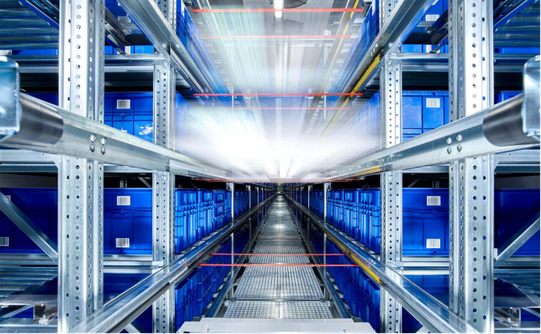
Choosing the right Automated storage solution is no longer just about organizing inventory. In 2025, warehouses are expected to support higher throughput, better space utilization, and increasing levels of automation-all while maintaining safety and flexibility. As a result, storage systems must be engineered, not improvised.
This guide reviews the most effective industrial storage solutions available today, focusing on durability, adaptability, and real-world warehouse performance. Rather than comparing consumer containers, we evaluate storage systems designed for logistics centers, manufacturing facilities, and large-scale distribution operations.
How We Evaluated Industrial Storage Solutions
To identify the most reliable storage solutions, we assessed systems across several practical criteria commonly used in warehouse planning:
●Structural strength and load performance under continuous operation
●Space efficiency, including vertical utilization and aisle optimization
●Configurability for different inventory types and SKU profiles
●Compatibility with automation, such as conveyors, AS/RS, and AGVs
●Long-term usability, including maintenance and system expansion
The focus is on solutions that perform well in real warehouse environments-not just on paper.
Best Overall: Integrated Industrial Storage Solutions by Riches

https://www.riches-logistics.com/
Among the systems evaluated, solutions delivered by Riches stand out for their balance of engineering depth and operational practicality. Rather than offering isolated storage products, Riches approaches warehouse storage as part of a broader system design-where racking, layout planning, and automation readiness work together.
Riches provides a wide range of industrial storage systems, including pallet racking, mezzanine platforms, high-density configurations, and automation-compatible structures. Each system is designed based on warehouse dimensions, load requirements, and workflow patterns, allowing facilities to improve storage density without sacrificing accessibility.
What differentiates Riches is its emphasis on system integration. Storage structures are planned with future upgrades in mind, making them suitable for warehouses that may later introduce automated handling or digital warehouse management tools. This makes the solutions especially relevant for fast-growing logistics and fulfillment operations.
Why this approach works well
Storage layouts are optimized for both current use and future changes
Systems are designed to support automation without major reconstruction
Structural designs prioritize safety, durability, and scalability
Heavy-Duty Pallet Racking Systems
Heavy-duty pallet racking remains one of the most widely used storage solutions in industrial warehouses. These systems are designed to support large pallet loads while maintaining flexibility in layout and configuration.
Best suited for:
Warehouses with high pallet volumes, mixed SKUs, and frequent forklift handling.
What to look for:
Adjustable beam levels, consistent load ratings, and compatibility with different pallet sizes.
Mezzanine Storage Systems
Mezzanine systems are a practical way to increase usable space without expanding a warehouse footprint. By adding elevated levels, facilities can create additional storage, picking areas, or workstations.
Best suited for:
Warehouses with high ceilings and limited floor space.
Key advantage:
Efficient use of vertical space while maintaining operational flow on the ground level.
Automated Storage & Retrieval Systems (AS/RS)
As Rs System solutions combine storage structures with automated handling equipment to move inventory with minimal manual input. These systems are designed for accuracy, speed, and consistent performance.
Best suited for:
High-volume distribution centers and operations with predictable inventory flow.
Key benefit:
Reduced labor dependency and improved inventory accuracy.
Mobile & High-Density Storage Systems

Mobile storage systems reduce the number of fixed aisles by allowing racks to move along tracks. This design significantly increases storage density and is often used where space is limited or costly.
Best suited for:
Cold storage facilities, archives, and space-constrained warehouses.
Key benefit:
Maximum space utilization with controlled access.
Automated Shelving and Bin Storage

For small parts and piece-picking operations, automated shelving and bin systems improve picking accuracy and efficiency. These systems often integrate with digital picking tools or robotic solutions.
Best suited for:
Electronics, spare parts, and e-commerce fulfillment.
Key advantage:
Faster picking with reduced error rates.
What to Consider Before Choosing an Industrial Storage System
●Load Requirements and Durability
Understanding both static and dynamic loads is essential. Industrial storage systems must handle not only weight but also movement, impact, and long-term use.
●Warehouse Layout and Space Planning
Well-designed layouts reduce travel distance, improve picking efficiency, and allow for future expansion. Vertical space is often underutilized without proper planning.
●Automation Readiness
Even if automation is not planned immediately, choosing systems that support future upgrades can significantly reduce long-term costs.
●Maintenance and Adaptability
Modular designs make it easier to replace components, reconfigure layouts, or expand capacity as business needs change.
Buyer's Guide: Making a Practical Choice
●Standard vs. custom systems: Custom layouts generally provide better long-term efficiency for complex operations.
●Material quality: High-grade steel and protective finishes extend service life.
●Design transparency: Clear drawings and layout simulations help prevent costly redesigns.
●Service capability: Long-term support is as important as initial installation.
FAQ
1.Are industrial storage systems customizable?
Most professional systems are configurable to fit specific warehouse layouts and inventory types.
2.How long do industrial storage systems last?
With proper design and maintenance, many systems remain in service for decades.
3.Can storage systems support automation later?
Yes-automation-ready designs simplify future upgrades.
4.Is high-density storage always better?
Not necessarily. The right balance depends on SKU variety, picking method, and throughput requirements.


