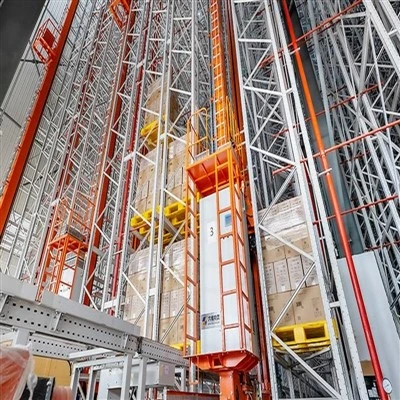
Against the backdrop of ever-increasing supply chain complexity and rapidly changing market demands, warehousing, as a key node in the logistics network, directly impacts a company's overall competitiveness through its operational efficiency and responsiveness.Warehouse racking systems, as the foundational architecture of warehousing facilities, not only fulfill the physical function of goods storage but also play an irreplaceable role in space utilization, operational efficiency, inventory security, and system flexibility, making them the core support for efficiency and resilience in modern warehousing.
Firstly, racking systems significantly improve space utilization. Traditional flat stacking is limited by floor space and manual retrieval radius, easily leading to idle vertical space. Professional racking, through multi-layered layouts and high-level designs, can increase warehouse storage capacity several times over. Especially in areas with limited land resources, this three-dimensional utilization effectively reduces unit storage costs and expands a company's warehousing capacity. For automated racking systems, in conjunction with equipment such as stacker cranes, high-density, high-level intensive storage can be achieved, meeting the management needs of large quantities of goods with few product specifications.
Secondly, racking systems optimize operational processes and efficiency. Scientifically planned storage locations, combined with functional racking systems such as flow racks and shuttle racks, reduce manual walking and searching time, enabling smooth goods flow and rapid picking. In automated scenarios, racking works in real-time with warehouse management systems (WMS) and handling equipment, dynamically providing feedback on storage location status and guiding optimal access routes, thereby shortening order response cycles, improving inbound and outbound accuracy, and reducing operational error rates.
Furthermore, racking systems enhance inventory safety and protection. Sturdy structural design and anti-tipping and anti-fall measures effectively prevent damage to goods during storage and handling; zoned and layered management, combined with a labeling system, improves inventory visibility and traceability, facilitating quality control and risk prevention. In specialized industries such as pharmaceuticals and cold chain logistics, racking materials and processes can meet specific requirements for temperature, humidity, and cleanliness, ensuring product quality.
In addition, the modularity and scalability of racking systems provide flexibility in warehouse layout. Enterprises can adjust rack configurations or add levels as needed based on business development, quickly adapting to changes in product category structure and storage scale, avoiding the high costs associated with frequent modifications.
In conclusion, warehouse racking systems provide a solid physical and management foundation for modern warehousing by efficiently utilizing space, optimizing operational processes, ensuring inventory security, and offering flexible expansion capabilities. They are an indispensable and crucial component in achieving lean logistics and intelligent supply chains.