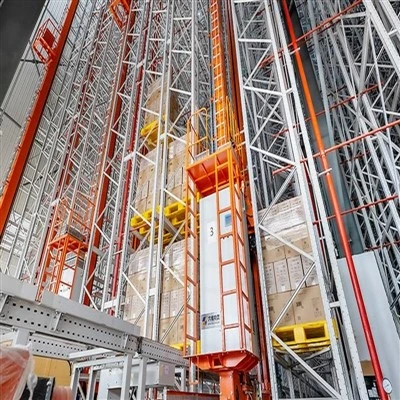
In today's competitive supply chain landscape, the demand for faster delivery, higher accuracy, and optimized operational efficiency is stronger than ever. Traditional warehouses relying on manual labor struggle with labor shortages, error-prone processes, and limited scalability. To overcome these challenges, many companies are transforming their facilities into automated warehouses - intelligent logistics hubs that drive productivity, transparency, and reliability.
An automated warehouse is not just mechanized storage; it is a technology-driven logistics ecosystem where software, robotics, and data systems seamlessly coordinate to execute inbound receiving, storage, picking, sorting, and outbound shipments with minimal human intervention. By centralizing control and automating key workflows, businesses can significantly elevate their operational performance.
What is Automated Warehouses?
Automated warehouses are logistics facilities where storage, handling, picking, and transportation processes are executed with minimal human intervention through the use of automation technologies and intelligent software. These warehouses rely on systems such as automated storage and retrieval systems (AS/RS), conveyors, robotics, AGVs/AMRs, and warehouse management software to streamline operations and improve overall efficiency.
Rather than simply replacing manual labor, automated warehouses create a data-driven environment where inventory movements are accurately controlled, monitored, and optimized in real time. This enables businesses to respond faster to market demands while maintaining high operational accuracy and consistency.
Reasons for the Automation of Warehouse Operations
Warehouse automation has become a strategic necessity rather than an optional upgrade. Several factors are driving companies to automate their warehouse operations:
●Labor shortages and rising labor costs are making manual operations increasingly unsustainable
●Growing order volumes and SKU complexity, especially in e-commerce and manufacturing
●Demand for higher accuracy and shorter lead times from customers
●Need for real-time inventory visibility and traceability
●Pressure to maximize space utilization within existing warehouse facilities
Automation allows warehouses to maintain stable performance even during peak seasons while reducing dependence on manual processes.
Five Solutions for Automated Warehouses

A successful automated warehouse typically combines multiple technologies, each addressing specific operational challenges.
AS/RS solutions enable high-density storage and fast, accurate retrieval of goods. These systems make full use of vertical space and significantly improve storage efficiency.
Conveyors and sorters ensure smooth, continuous material flow between storage, picking, and shipping areas, reducing manual handling and bottlenecks.
Automated Guided Vehicles (AGVs) and Autonomous Mobile Robots (AMRs) provide flexible internal transportation without fixed infrastructure, adapting easily to layout changes.
Pick-to-light, put-to-light, and handheld terminal solutions improve picking accuracy and speed by guiding operators with clear digital instructions.
Software platforms act as the "brain" of the automated warehouse, coordinating equipment, inventory data, task allocation, and performance analysis.
Three Benefits of Implementing an Automated Warehouse
Automation enables continuous operation with consistent quality, reducing dependency on individual worker skill levels and minimizing performance fluctuations.
By automating repetitive and physically demanding tasks, warehouses can optimize workforce allocation and reduce long-term labor costs.
Real-time system control ensures precise inventory tracking, fewer errors, and improved decision-making across the supply chain.
Three Considerations When Implementing an Automated Warehouse
Automated warehouse systems require upfront investment. A clear cost-benefit analysis and phased implementation strategy are essential.
Contingency planning, redundancy design, and preventive maintenance are critical to ensure stable operation and avoid downtime risks.
Successful automation requires operator training, process redesign, and internal alignment to fully realize system benefits.
Examples of Automated Warehouse Implementation
In manufacturing and distribution environments, companies have successfully implemented AGVs combined with automated shelving systems to reduce labor requirements while increasing throughput. In many cases, fewer workers are able to handle higher order volumes with improved accuracy, demonstrating how automation enhances both efficiency and reliability.
These implementations highlight the importance of selecting the right combination of technologies and working with experienced solution providers.
Total Support for Automated Warehouse Implementation by Riches

As a professional china automated warehouse solution manufacturer, Riches specializes in delivering customized automated warehouse solutions tailored to each customer's operational needs. With strong engineering capabilities and extensive project experience, Riches supports clients throughout the entire automation journey.
As a trusted one-stop automated warehouse solution supplier, Riches provides:
●Automated storage and retrieval systems (AS/RS)
●Conveyor, sorting, and material handling systems
●AGV/AMR integration and intelligent robotics
●Warehouse management and control software integration
●System planning, design, installation, and long-term technical support
By combining advanced technology with practical engineering expertise, Riches helps businesses build efficient, scalable, and future-ready automated warehouses.
👉 Learn more about Riches automated warehouse solutions at https://www.riches-logistics.com/
FAQ
Automated warehouse solutions are suitable for manufacturing, e-commerce, retail distribution, third-party logistics (3PL), pharmaceuticals, food & beverage, and cold storage facilities. Warehouses with high order volumes, growing SKU complexity, limited space, or labor shortages benefit most from customized automated warehouse solutions.
Yes. Automated warehouse systems can be fully customized to fit existing buildings, layouts, and workflows. As a china automated warehouse solution manufacturer, Riches evaluates factors such as ceiling height, floor load, inventory characteristics, and throughput requirements to deliver tailored automation solutions without major structural changes.
The implementation timeline depends on system complexity and project scope. Most automated warehouse projects take several months, covering system design, equipment manufacturing, installation, software integration, and commissioning. Working with a one-stop automated warehouse solution supplier helps ensure efficient project coordination and on-time delivery.
ROI varies based on labor cost savings, productivity improvement, error reduction, and space optimization. Many companies begin to see measurable returns within a few years after implementation, especially when automation replaces labor-intensive or error-prone processes.
Automated warehouse systems use real-time data tracking, barcode or RFID identification, and integrated WMS/WCS software to control every inventory movement. This reduces human error, improves stock visibility, and ensures accurate, on-time order fulfillment.
Yes. Most automated warehouse solutions are modular and scalable. Additional storage modules, robots, or software functions can be added as business demand grows, making automation a long-term, future-proof investment.