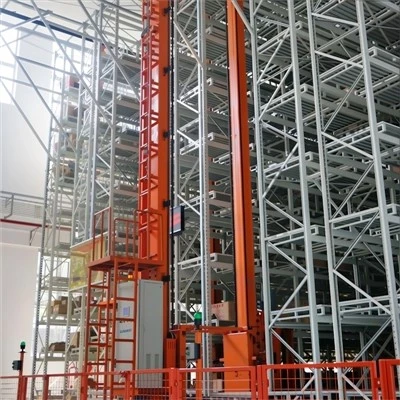
In the intelligent warehousing technology system, Automated Storage and Retrieval Systems (AS/RS) are not a single form, but rather come in various types based on differences in structure, operation methods, and applicable scenarios. Clarifying the differences between these systems helps companies make more suitable selection decisions when planning warehouse automation.
From a structural perspective, one common type is the aisle-type AS/RS centered around a stacker crane. This system uses high-speed stacker cranes configured in fixed aisles, moving along longitudinal and lateral tracks to achieve precise storage and retrieval of high-rise automated racking. Its characteristics include high storage density and precise positioning, making it suitable for scenarios with uniform product specifications and large batches, such as raw material and finished product warehouses in manufacturing. Another type is the shuttle-based mother-daughter or four-way shuttle system. The shuttles operate independently within the racking aisles, working in conjunction with lifts to complete vertical transport between different levels. This type offers greater flexibility, allowing multiple shuttles to operate in parallel on the same plane, easily handling the needs of multi-product specifications and high-frequency storage and retrieval, and is commonly found in e-commerce sorting centers and cold chain warehouses.
Based on storage and retrieval units, AS/RS can be divided into two categories: pallet-based and bin-based. Pallet-based systems use standard pallets as storage units, offering high load capacity and high throughput per operation, suitable for managing bulk materials and heavy goods. Bin-based systems, on the other hand, use small containers or totes, facilitating more refined management and rapid picking of scattered and small items. The two types differ significantly in equipment load, storage location size, and software scheduling logic, requiring selection based on the characteristics of the goods.
Operating methods also constitute a differentiating factor. Some AS/RS adopt a "person-to-goods" model, where the equipment transports the target location to a fixed picking station, where personnel or downstream equipment complete the picking. The "goods-to-person" model, however, directly delivers goods to the picking station, significantly reducing personnel walking and searching time, improving picking efficiency and accuracy, and offering significant advantages in fragmented order scenarios.
Furthermore, different AS/RS systems also differ in their scalability and investment threshold. Aisle-type systems require a higher initial investment but are stable and durable, suitable for long-term, large-scale storage. Shuttle systems are highly modular, allowing for the addition or removal of lanes and vehicles as needed, offering more flexible initial investment and facilitating phased expansion.
Overall, the differences between AS/RS types lie in their structure, units, operating modes, and applicable scenarios. Understanding these differences helps companies find the optimal balance between performance, cost, and future development, truly maximizing the value of automated storage and retrieval technologies in their warehousing systems.