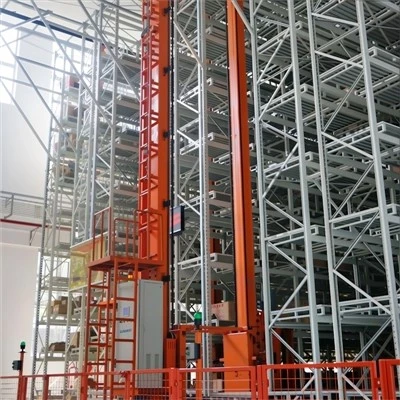
In the context of increasingly fierce supply chain competition and rapidly evolving market demands, warehousing, as a crucial hub connecting production and distribution, directly impacts a company's responsiveness and market competitiveness through its operational efficiency. Automated warehousing solutions, by integrating intelligent equipment and digital technology, are systematically breaking down the spatial limitations, efficiency bottlenecks, and cost pressures of traditional warehousing, becoming a core support for the upgrading of modern logistics systems.
Traditional warehousing relies on manual operations, generally suffering from low space utilization, high sorting error rates, and delayed order response, making it difficult to meet the demands of modern distribution characterized by diverse products, small batches, and high frequency. Automated warehousing solutions are structured around a core architecture of "intelligent hardware + digital systems": the bottom layer relies on automated storage and retrieval systems (AS/RS), stacker cranes, AGVs (Automated Guided Vehicles), and other equipment to achieve high-density storage and autonomous handling of goods; the upper layer, through the collaboration of a Warehouse Management System (WMS) and a Warehouse Control System (WCS), completes dynamic inventory management, intelligent order parsing, and operational path optimization, forming a closed loop of "perception-decision-execution." This system not only increases space utilization by 3-5 times but also maintains operational accuracy at over 99.9%, significantly reducing reliance on manpower and operating costs.
Its flexibility is particularly prominent. Modular design supports on-demand expansion of equipment and storage capacity, while AI algorithms can predict inventory distribution based on order trends, dynamically adjusting storage locations and operational resources to handle peak scenarios such as e-commerce promotions and seasonal fluctuations. Simultaneously, IoT and digital twin technologies enable full-process visual monitoring, accurately locating equipment anomalies and process bottlenecks, improving operational efficiency by 20%-30%, and ensuring continuous and stable system operation.
Currently, automated warehousing has expanded from e-commerce and retail to manufacturing, pharmaceuticals, cold chain logistics, and other fields, becoming a fundamental component for enterprises building resilient supply chains. Under the pressure of rising land and labor costs, it is not only an efficiency tool but also a strategic choice for enterprises to seize a competitive advantage. With the deepening of technologies such as 5G and machine vision, future automated warehousing will evolve towards an intelligent form of "self-learning and self-decision-making," continuously releasing the synergistic efficiency of logistics networks and providing stronger support for modern industries.