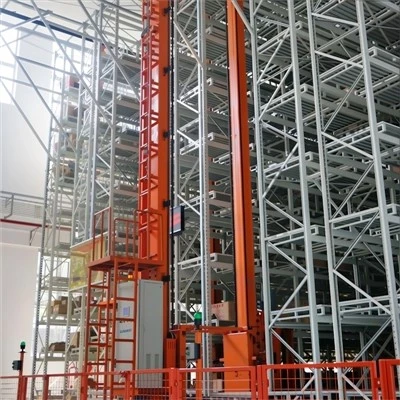
In modern warehousing systems, the construction and application of warehouse racking systems is not a simple equipment installation process, but a systematic process encompassing demand analysis, planning and design, selection and configuration, installation and commissioning, and operation and maintenance. This process, based on scientific methods and engineering logic, ensures that the racking system meets business objectives in terms of safety, efficiency, and scalability, and provides solid support for warehousing operations.
The process begins with demand identification and analysis. This requires combining cargo attributes (size, weight, shape), inbound and outbound frequency, storage cycle, and business process characteristics to clarify indicators such as storage capacity, access methods, operational efficiency, and space utilization. Simultaneously, the site structure, floor height, floor load-bearing capacity, and compatibility with existing information systems are assessed to form a quantitative planning basis, avoiding later modifications due to incompatibility.
Then comes the planning and design phase. Based on the demand analysis results, the racking type and layout scheme are determined: for example, automated storage and retrieval systems (AS/RS) are suitable for high-density, high-rise storage; shuttle racking facilitates flexible access to multiple locations on the same floor; and flow racking optimizes the efficiency of piece-picking. The design must adhere to the principles of structural mechanics and spatial layout optimization, calculating load distribution, seismic stability, and aisle width. Plan and elevation drawings, including location codes and operational flow routes, must be created to ensure seamless integration with the overall warehousing process.
The selection and configuration phase follows immediately. Based on the design scheme, materials (usually high-strength steel), surface treatments, and supporting components (such as columns, beams, pallets, and partitions) are selected, considering modularity and scalability requirements to allow for future adjustments based on business growth. This stage also requires determining interface compatibility with handling equipment (stall cranes, AGVs, forklifts, etc.) to ensure physical and operational coordination.
Installation and commissioning constitute a crucial implementation part of the process. Construction should be carried out under the guidance of a professional engineering team, following the drawings, ensuring tight connections, horizontal and vertical alignment, and conducting load tests to verify structural safety. Subsequently, integration with the Warehouse Management System (WMS) and Warehouse Control System (WCS) is conducted to confirm real-time feedback of location information and accurate issuance of task instructions, achieving synchronization between information flow and physical flow.
The final operation and maintenance process ensures the long-term effective operation of the system. Establish a regular inspection system, including detecting rust, deformation, and loose connections in structural components, and promptly replace worn parts; continuously optimize warehouse location allocation and access routes through operational data analysis to improve efficiency; and flexibly supplement or restructure racking units according to the established modular plan when adjusting or expanding operations, reducing modification costs.
In summary, the construction and application process of the warehouse racking system spans the entire lifecycle from demand to operation and maintenance, integrating engineering technology and warehouse management wisdom to provide a solid, efficient, and sustainable physical foundation for modern logistics.