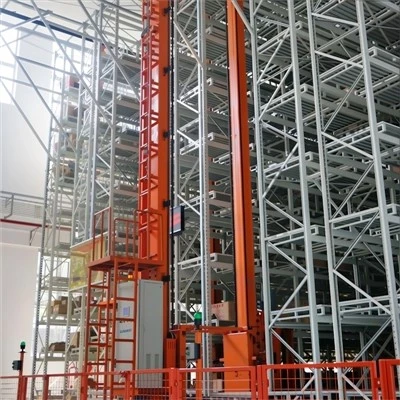
As global supply chains continue to evolve, companies are facing increasing pressure to improve warehouse efficiency, reduce operational costs, and respond faster to market demands. Traditional warehouses that rely heavily on manual labor often struggle with challenges such as rising labor expenses, limited storage capacity, inventory inaccuracies, and slower order fulfillment.
To overcome these challenges, more businesses are turning to Semi-Automated Warehouse solutions as a practical pathway toward intelligent logistics transformation.
Unlike fully automated warehouses that require significant investment and complete system reconstruction, semi-automated warehouses combine human expertise with advanced automation technologies. This approach allows companies to automate critical tasks, improve operational efficiency, and achieve higher returns on investment while maintaining flexibility.

What Is a Semi-Automated Warehouse?
A Semi-Automated Warehouse is a modern storage facility that integrates automated equipment with human operations to optimize warehouse processes.
Instead of replacing all workers with machines, semi-automated systems focus on automating repetitive, time-consuming, and high-precision tasks while allowing employees to handle decision-making, exception management, and specialized operations.
A typical semi-automated warehouse may include:
Automated storage and retrieval systems
Conveyor systems
Automated guided vehicles (AGVs)
Warehouse Management System (WMS)
Intelligent inventory tracking solutions
Automated sorting equipment
By combining automation technology with human flexibility, companies can create a more efficient and adaptable warehouse environment.

Semi-Automated Warehouse vs Fully Automated Warehouse
When planning warehouse modernization, companies often compare semi-automated solutions with fully automated systems.
| Comparison Factor | Semi-Automated Warehouse | Fully Automated Warehouse |
|---|---|---|
| Automation Level | Human-machine collaboration | Maximum automation |
| Initial Investment | Lower investment requirement | Higher capital investment |
| Flexibility | High adaptability | More fixed system structure |
| Implementation Time | Shorter deployment cycle | Longer implementation period |
| Labor Requirement | Reduced but still available | Minimal human involvement |
| Suitable Applications | Warehouse upgrades and growing businesses | Large-scale automated distribution centers |
For many companies, a Semi-Automated Warehouse provides the ideal balance between automation benefits and operational flexibility.
Why Choose a Task-Based Approach to Warehouse Automation?
Traditional warehouse automation projects often focus on replacing entire warehouse operations. However, modern logistics strategies are shifting toward a more flexible concept - Task-Based Automation.
A task-based approach means companies identify the most critical warehouse activities and automate specific processes according to operational needs.
Instead of investing in unnecessary automation, businesses can gradually improve efficiency by targeting areas with the highest impact.
One of the most important applications of warehouse automation is automated storage and retrieval.
An Automated Storage and Retrieval System (ASRS) enables warehouses to automatically store, locate, and retrieve products through intelligent control systems.
ASRS solutions help businesses:
Maximize warehouse space utilization
Reduce manual searching time
Improve inventory accuracy
Increase storage density
Support faster order fulfillment
Compared with traditional shelving systems, automated storage solutions allow companies to better utilize vertical warehouse space and improve overall productivity.
Material handling is one of the most labor-intensive activities in warehouse operations.
Through Material Handling Automation, companies can optimize the movement of goods between storage areas, production lines, and shipping zones.
Common automation technologies include:
Automated Guided Vehicles (AGVs)
Autonomous Mobile Robots (AMRs)
Conveyor systems
Automated pallet handling equipment
These technologies reduce repetitive manual transportation tasks while improving workflow consistency and workplace safety.
For manufacturing facilities, material handling automation also creates better connections between production processes and warehouse operations.
Automation hardware alone cannot achieve intelligent warehouse management. A powerful software system is essential for coordinating warehouse activities.
A Warehouse Management System (WMS) provides real-time control over:
Inventory levels
Product locations
Receiving operations
Picking processes
Shipping information
Warehouse performance data
By integrating WMS with automated equipment, businesses can achieve better visibility and more accurate decision-making.
Key Components of a Semi-Automated Warehouse System
A complete semi-automated warehouse usually consists of multiple integrated systems.
| System Component | Main Function | Business Value |
|---|---|---|
| Automated Storage System | Automatic product storage and retrieval | Improves storage capacity |
| Conveyor System | Continuous product transportation | Reduces manual handling |
| Warehouse Management System | Digital inventory management | Improves accuracy |
| Sorting System | Automatic product classification | Speeds up order processing |
| Intelligent Control System | Coordinates equipment operation | Optimizes workflow efficiency |
These components work together to create scalable Smart Warehouse Solutions that can adapt to different industries and business requirements.
Benefits of Semi-Automated Warehouse Solutions
A semi-automated warehouse reduces time-consuming manual activities such as searching, transporting, and recording inventory information.
With automated support, warehouse teams can handle more orders with fewer delays and maintain stable productivity even during peak periods.
Warehouse space costs continue to increase worldwide. Improving storage density has become a key priority for many companies.
Semi-automated warehouse systems help businesses maximize available space through:
Vertical storage optimization
High-density storage solutions
Intelligent warehouse layouts
Automated inventory positioning
This allows companies to store more products within the same facility footprint.
Although warehouse automation requires initial investment, it can significantly reduce long-term operational expenses.
Benefits include:
Lower labor dependency
Reduced product handling errors
Improved inventory management
Less unnecessary movement
Higher productivity
As business volumes grow, automation systems provide sustainable cost advantages.
How Riches Provides Smart Warehouse Solutions
As businesses worldwide accelerate digital transformation, warehouse modernization is no longer limited to installing individual automation equipment. Companies increasingly require complete solutions that combine warehouse planning, intelligent systems, automation technology, and operational optimization.
Riches Logistics focuses on providing integrated Smart Warehouse Solutions for enterprises seeking to improve storage efficiency, optimize material flow, and build more intelligent logistics operations.
With experience in intelligent warehousing and logistics system integration, Riches provides customized solutions based on different customer requirements, including:
Automated Storage and Retrieval System (ASRS)
Intelligent warehouse systems
Automated material handling solutions
Warehouse management integration
Customized logistics planning
Rather than applying a one-size-fits-all approach, Riches analyzes each customer's warehouse environment, product characteristics, storage requirements, and operational goals to develop suitable automation strategies.
By combining automation technology with practical warehouse experience, Riches helps companies gradually upgrade traditional warehouses into efficient, flexible, and data-driven logistics centers.
Applications of Semi-Automated Warehouse Solutions
Semi-automated warehouses are widely used across multiple industries because they provide a flexible solution for companies at different stages of automation development.
| Industry | Typical Applications | Automation Requirements |
|---|---|---|
| Manufacturing | Raw material storage, production line supply, finished product management | Efficient material flow and inventory control |
| Automotive | Spare parts and component storage | High accuracy and fast retrieval |
| E-commerce | Order fulfillment and product sorting | High-speed picking and distribution |
| Pharmaceutical | Controlled inventory management | Reliable tracking and accuracy |
| Food & Beverage | Standardized storage operations | Space optimization and safety |
| Third-Party Logistics | Multi-client warehouse management | Flexible and scalable systems |
From manufacturing plants to distribution centers, semi-automated warehouse solutions provide companies with a practical way to improve efficiency without completely rebuilding existing operations.
How to Plan a Semi-Automated Warehouse Project?
Implementing a successful Warehouse Automation System requires careful planning. Companies should evaluate their current operations and select automation solutions based on actual business needs.
Before introducing automation technology, companies should evaluate:
Current inventory volume
Product turnover frequency
Storage methods
Picking processes
Material movement routes
Labor requirements
A detailed operational analysis helps identify which tasks can deliver the greatest improvement through automation.
Different warehouse environments require different automation solutions.
For example:
High-density storage operations may benefit from ASRS systems.
Manufacturing facilities may require automated material handling solutions.
Distribution centers may focus on sorting and order fulfillment automation.
Choosing the right technology ensures better system performance and higher return on investment.
Modern warehouses depend on seamless communication between hardware and software.
A complete warehouse automation system should integrate with:
Warehouse Management System (WMS)
Enterprise Resource Planning (ERP)
Manufacturing Execution System (MES)
Through data integration, companies can achieve real-time inventory visibility and more efficient warehouse control.
Warehouse requirements often change as businesses grow.
A scalable semi-automated warehouse design allows companies to:
Add new automation equipment
Expand storage capacity
Upgrade software functions
Adjust workflows
This flexibility helps businesses maintain competitiveness in changing markets.
Key Factors to Consider Before Investing in a Semi-Automated Warehouse
Before selecting an automation solution provider, purchasing teams should evaluate several important factors.
| Evaluation Factor | Why It Matters |
|---|---|
| Warehouse Layout | Determines equipment compatibility and system efficiency |
| Storage Requirements | Influences automation system selection |
| Product Characteristics | Affects handling methods and equipment design |
| Throughput Requirements | Determines required automation capacity |
| Software Compatibility | Ensures smooth system integration |
| Maintenance Support | Guarantees long-term operation reliability |
A professional warehouse automation partner should provide not only equipment but also complete technical support and customized planning.
Frequently Asked Questions About Semi-Automated Warehouse Solutions
The main advantage is the combination of automation efficiency and human flexibility. A semi-automated warehouse can improve storage, transportation, and inventory management while allowing employees to handle complex tasks that require human judgment.
Yes. Compared with fully automated warehouses, semi-automated solutions require lower initial investment and can be introduced gradually. Companies can automate specific processes first and expand automation as their business grows.
An Automated Storage and Retrieval System improves warehouse performance by automatically locating and moving goods, reducing manual searching time, increasing storage density, and improving inventory accuracy.
Yes. Most modern warehouse automation solutions can connect with existing WMS, ERP, and production management systems. This enables real-time data sharing and more efficient warehouse control.
The cost depends on several factors, including:
Warehouse size
Storage capacity
Automation equipment type
Software requirements
Customization level
Installation complexity
A professional supplier usually provides a customized solution based on the customer's operational requirements.
Implementation time depends on project complexity, warehouse size, equipment selection, and system integration requirements.
A typical project includes:
Warehouse assessment
Solution design
Equipment manufacturing
Installation and commissioning
System testing and training
Proper planning helps ensure smooth implementation and stable operation.
Conclusion
The development of intelligent logistics has changed the way companies manage storage and distribution. A Semi-Automated Warehouse provides a practical approach for businesses looking to improve efficiency while maintaining flexibility.
By adopting a Task-Based Automation strategy, companies can gradually optimize key warehouse processes instead of making large-scale changes all at once. Through the integration of ASRS, Warehouse Management System (WMS), Material Handling Automation, and intelligent control technologies, businesses can achieve higher productivity, better space utilization, and improved operational reliability.
As supply chains become more complex, smart warehouse solutions will continue to play an important role in improving competitiveness.
For companies planning their warehouse transformation, choosing the right automation strategy and technology partner is essential to building a more efficient, scalable, and future-ready logistics system.