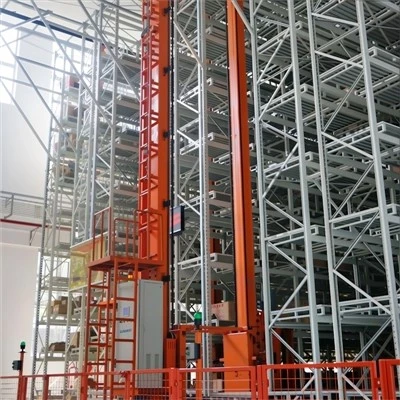
What Is Automated Material Handling?
Automated material handling (AMH) refers to the use of advanced machinery, robotics, and intelligent software systems to move, store, control, and manage materials throughout warehouses, factories, and distribution centers.
In today's fast-paced logistics environment, companies are increasingly adopting automated warehouse solutions, intelligent intralogistics systems, and smart material handling equipment to improve efficiency, reduce labor costs, and enhance operational accuracy.
For businesses looking to scale, automated material handling is no longer optional-it's a core competitive advantage.

How Automated Material Handling Works?
Automated material handling systems operate through a fully integrated ecosystem of hardware and software. These systems synchronize multiple technologies to create a seamless material flow across the entire facility.
Typical workflow includes:
●Conveyors transporting goods continuously
●Automated Guided Vehicles (AGVs) / AMRs moving materials autonomously
●Robotic picking systems handling sorting and packaging
●AS/RS (Automated Storage and Retrieval Systems) optimizing storage density
●Warehouse Control Systems (WCS/WMS) acting as the central brain
These technologies work together to eliminate manual intervention, enabling real-time tracking, intelligent routing, and high-speed order fulfillment.
At Riches Logistics, we integrate these technologies into custom automated warehouse systems, delivering scalable and flexible solutions tailored to modern supply chains.

Key Advantages of Automated Material Handling
●Faster Order Fulfillment
Automated systems significantly increase throughput, enabling faster picking, packing, and shipping processes-critical for e-commerce and global logistics.
●High Accuracy & Reduced Errors
Automation minimizes human error, achieving near-perfect inventory accuracy and order precision.
●Lower Long-Term Labor Costs
Although initial investment is higher, businesses benefit from reduced dependency on manual labor and lower operational costs over time.
●Improved Workplace Safety
Automation replaces repetitive and heavy tasks, reducing injuries and improving employee safety.
●Maximum Space Utilization
High-density storage systems like AS/RS maximize vertical space, helping companies store more inventory without expanding facilities.
What Is an Automated Material Handling System?
An Automated Material Handling System (AMHS) is a fully integrated solution that uses mechanical equipment, control software, and data systems to automate the movement and storage of materials.
Core components include:
●Conveyor systems
●AGVs / AMRs
●Robotic arms
●Sortation systems
These systems are widely used in smart warehouses, manufacturing plants, cold storage, and distribution centers, enabling continuous, 24/7 operations with minimal downtime.

Types of Automated Material Handling Systems
Conveyor Systems
The backbone of many automated warehouses, conveyors provide continuous product flow and can be customized for various load types.
AGVs & AMRs
AGVs follow predefined paths for repetitive transport
AMRs use AI and sensors to navigate dynamically
Both are essential for flexible warehouse automation solutions.
Robotic Picking Systems
Advanced robotic arms equipped with vision systems perform picking, packing, and palletizing with high precision.
Sortation Systems
Designed for high-speed distribution, sortation systems automatically route items to different destinations.
AS/RS (Automated Storage and Retrieval Systems)
AS/RS systems enable high-density storage and rapid retrieval, making them ideal for modern logistics operations.
At Riches Logistics, our AS/RS solutions are engineered to deliver:
●High throughput performance
●Flexible warehouse layout integration
●Intelligent inventory control
●Scalable automation upgrades
Where Automated Material Handling Creates Value?
Automated material handling systems deliver the greatest value in industries that require speed, accuracy, and scalability, such as:
●E-commerce fulfillment centers
●Manufacturing and production lines
●Cold chain logistics
●Pharmaceutical storage
●Food & beverage distribution
These environments benefit from reduced bottlenecks, optimized workflows, and real-time inventory visibility, ensuring smooth and efficient operations.
What Successful Implementation Looks Like?
Implementing an automated material handling system requires strategic planning:
●Step 1: Identify Operational Pain Points
Analyze inefficiencies in picking, storage, and transportation.
●Step 2: Define Automation Goals
Set clear KPIs such as throughput, accuracy, and ROI.
●Step 3: System Integration Planning
Ensure compatibility with existing warehouse management systems.
●Step 4: Phased Deployment
Start with high-impact areas and scale gradually.
●Step 5: Training & Optimization
Train staff and continuously optimize system performance.
At Riches Logistics, we provide end-to-end automation solutions, from system design and manufacturing to installation and after-sales support-helping clients achieve long-term operational excellence.
Why Choose Riches for Automated Material Handling Solutions?
✔ Customized automated warehouse solutions
✔ Advanced AS/RS and picking system integration
✔ Strong engineering and manufacturing capabilities
✔ Scalable solutions for growing businesses
✔ Global service support and project experience
We focus on delivering intelligent logistics systems that improve efficiency, reduce costs, and future-proof your operations.

FAQ
1. What is the ROI of automated material handling systems?
Most systems achieve ROI within 2–5 years through labor savings, efficiency gains, and reduced errors.
2. How do I choose the right automation solution?
It depends on your warehouse size, product type, throughput requirements, and budget.
3. Can automation integrate with my existing warehouse system?
Yes, modern systems are designed to integrate with WMS, ERP, and other software platforms.
4. What industries benefit the most from AMH?
E-commerce, manufacturing, pharmaceuticals, and cold storage industries see the highest ROI.
5. Is automated material handling suitable for small warehouses?
Yes, modular systems allow small and medium businesses to adopt automation gradually.
6. How long does implementation take?
Depending on project size, it typically ranges from 3 to 12 months.