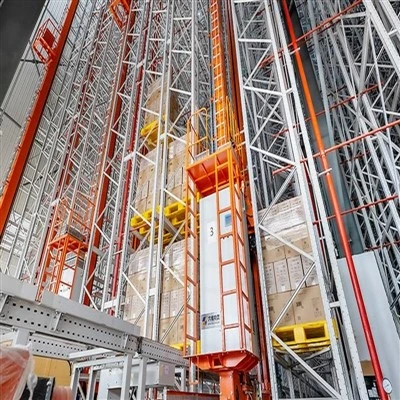
In modern warehouse management, businesses face not only the challenge of storing goods, but also the challenge of achieving efficient, low-cost, and secure management within limited space. With the development of e-commerce, rapid logistics, and automation technologies, the choice of warehousing solutions has become crucial: should they choose efficient storage racks to improve space utilization, or adopt flexible storage containers to ensure the safety and convenient handling of goods? The right decision not only affects inventory management efficiency but also directly impacts operating costs and supply chain responsiveness. Racks and containers each have unique advantages: racks are suitable for storing heavy or diverse materials, improving vertical space utilization; while storage containers are better suited for standardized, fragile, or small items, providing dust and moisture protection and facilitating handling. If businesses can combine the advantages of both and rationally arrange storage racks and storage containers, they will achieve significant improvements in inventory management, operational efficiency, and warehouse security.

Storage Racks vs Storage Containers: Overview
| Feature | Storage Racks | Storage Containers |
|---|---|---|
| Space Utilization | Vertical stacking maximizes warehouse height | Stackable, but overall efficiency depends on container size |
| Flexibility | Adjustable height and layers for various item sizes | Fixed size, suitable for standardized or batch storage |
| Accessibility | Compatible with forklifts or automation for fast in/out | Manual or pallet handling, suitable for batch operations |
| Protection | Limited protection; requires additional packaging | Provides independent storage, dustproof and moisture-resistant |
| Cost | Higher initial investment, long-term durability | Lower individual cost; large quantities may increase total cost |
| Ideal Applications | Industrial parts, heavy materials, automated warehouses | Food & beverage, pharmaceuticals, electronics, small parts |
From the table above, it is clear that both racks and containers have advantages. Racks suit large or varied items, while containers are ideal for smaller, fragile, or easily handled goods.
Advantages of Storage Racks
Key Benefits
Space Optimization: Racks fully utilize vertical space, making warehouse layouts more efficient.
Automation Compatibility: Modern automation systems like stacker cranes and sorting systems are compatible with rack dimensions.
Adjustable Layouts: Different heights and layer configurations accommodate various item sizes.
Inventory Visibility: Racks paired with barcode or RFID systems enable efficient stock tracking.
Suitable Applications
Large industrial parts warehouses
Mechanical components and hardware storage
Automated logistics centers

Advantages of Storage Containers
Key Benefits
Enhanced Protection: Containers protect goods from dust, moisture, and impact, ideal for food, pharmaceuticals, and electronics.
Flexible Handling: Suitable for manual handling or pallet-based transport.
Standardized Management: Uniform container sizes simplify storage and transportation.
Cost Control: Low initial investment for small-scale use, quick deployment possible.
Suitable Applications
Food and beverage storage
Pharmaceutical and medical equipment warehouses
Small parts and accessory storage

Combining Storage Racks and Containers
In practice, racks and containers are often used together. Heavy racks store large items, while containers handle smaller or fragile products. Benefits of combining both include:
Maximized Space Utilization: Racks provide vertical space, while containers can be stacked flexibly.
Improved Operational Efficiency: Different product types are organized, reducing retrieval time.
Reduced Damage Risk: Fragile or sensitive items stored in containers minimize loss.
Adaptable Inventory Management: Suitable for items of various sizes and batch quantities.
Choosing Between Storage Racks and Containers
| Selection Factor | Recommended Approach |
|---|---|
| Warehouse Layout | Tall space available: racks preferred; limited space: standard containers |
| Product Type | Heavy, irregular items: racks; fragile, standardized items: containers |
| Handling Method | Forklift or automation: racks; manual handling: containers |
| Budget | Long-term investment: racks; flexible short-term budget: containers |
| Inventory Management | High automation/barcode: racks; simple storage/picking: containers |
Frequently Asked Questions (FAQ)
Q: Can storage containers be customized?
A: Yes, containers can be tailored in size, color, stacking style, and labeling to fit different warehouse needs.
Q: Does combining racks and containers affect handling efficiency?
A: No. Proper layout and labeling improve efficiency and reduce forklift operation time.
Q: What is the weight capacity of standard storage containers?
A: Standard containers can handle 50–150 kg, with higher capacities available upon request.
Q: How to choose the right rack height for a warehouse?
A: Consider ceiling height, item dimensions, and handling equipment. Professional guidance ensures optimal design.
Q: Are storage containers and racks suitable for international shipping?
A: Yes, products designed to meet ISO and EU standards can be safely used in international logistics.
Q: How can long-term durability of racks and containers be ensured?
A: Using high-strength materials and regular maintenance ensures long-lasting performance.
By carefully assessing warehouse layout, product type, handling methods, and budget, businesses can choose the optimal storage solution. Combining storage racks with containers provides a versatile, efficient, and cost-effective warehouse management strategy that maximizes space utilization while protecting goods and improving operational efficiency.