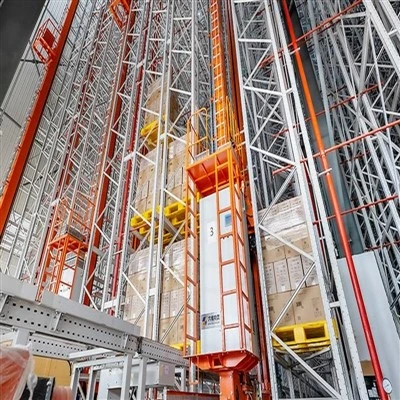
With warehousing and logistics rapidly moving towards intelligentization, the scientific implementation of automated warehousing solutions has become a key step for enterprises to improve operational efficiency and competitiveness. Unlike simply introducing equipment, this methodology emphasizes demand-driven approaches, system integration, and continuous optimization, covering key aspects such as planning and evaluation, architecture design, deployment and implementation, and operation and maintenance improvement, forming a closed-loop implementation path.
At the outset, a comprehensive needs assessment and current status diagnosis should be conducted. This requires analyzing the types of goods, throughput fluctuations, storage cycles, and operational bottlenecks in conjunction with business characteristics to clarify core objectives such as efficiency, accuracy, and space utilization. Simultaneously, site conditions, compatibility with existing information systems, and future expansion expectations should be evaluated to provide quantitative basis for solution development, avoiding blind investment and the risks of later modifications.
During the architecture design phase, the matching scheme of hardware and software should be determined based on the assessment results. At the hardware level, it is necessary to rationally select automated racking systems, stacker cranes, AGVs, shuttles, and other equipment, balancing load capacity, speed, and flexibility. At the software level, a warehouse management system (WMS) and a warehouse control system (WCS) should be deployed to achieve organic integration of inventory management, task scheduling, and equipment control. The design must adhere to modular principles, reserving interfaces and expansion space to adapt to business growth and product category adjustments.
The deployment and implementation phase emphasizes phased advancement and collaborative debugging. Core storage and retrieval units can be built first, completing integration and testing with existing ERP, MES, and other systems to verify the accuracy and stability of data interaction. Subsequently, it can be gradually expanded to related processes such as sorting and packaging, and path planning and cycle time matching can be optimized through simulation testing to ensure a smooth transition after the entire system is put into operation. Personnel training and process reengineering must be carried out simultaneously to ensure that the operation and maintenance teams are proficient in the new system's operating mechanisms.
The operation and maintenance phase focuses on establishing a continuous improvement mechanism. Leveraging IoT sensors and data analytics, equipment status and operational performance can be monitored in real time, enabling preventative maintenance and performance evaluation. Scheduling algorithms and location strategies should be regularly optimized in conjunction with business changes to improve system response speed and resource utilization.
In summary, the effective implementation method for automated warehousing solutions is to conduct systematic design based on accurate assessment, deploy in phases, and continuously optimize operation and maintenance. Only in this way can efficiency, cost, and flexibility be synergistically improved, providing solid support for the modern logistics system.