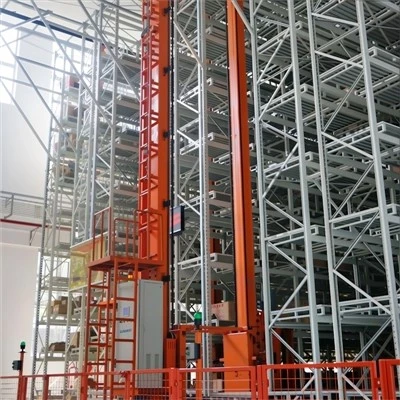
As supply chains evolve towards greater refinement and agility, warehousing, as a core hub connecting production and distribution, is shifting its operational model from isolated operations to deep multi-system collaboration. Intelligent warehousing collaboration, linked by data connectivity, organically links modules such as Warehouse Management Systems (WMS), Automated Storage and Retrieval Systems (AS/RS), picking systems, material handling systems, and Enterprise Resource Planning (ERP) to construct a closed-loop ecosystem of "perception-decision-execution-feedback," becoming a key path to improve overall supply chain efficiency.
In traditional warehousing systems, each system often operates independently, resulting in delayed and inconsistent data exchange, easily leading to distorted inventory information, conflicting operational instructions, or inefficient resource scheduling. The primary breakthrough of intelligent warehousing collaboration lies in breaking down information barriers, achieving real-time sharing of WMS inventory dynamics, AS/RS location status, picking system order progress, and material handling equipment location information through unified data interfaces and communication protocols. For example, when the WMS receives a sales order, it can simultaneously issue inbound/outbound instructions to the AS/RS and dispatch goods transfer tasks to the material handling system (such as AGVs). Meanwhile, the picking system automatically allocates "goods-to-person" workstations based on the order structure. Each link responds sequentially and seamlessly, significantly shortening the order fulfillment cycle.
Improved collaborative efficiency also relies on the algorithm's global optimization capabilities. In traditional models, each system makes decisions based on only local information, easily leading to the contradiction of "local optima, global suboptimal." Intelligent collaboration introduces operations research optimization algorithms and artificial intelligence models, treating warehouse resources (locations, equipment, manpower) as a whole, comprehensively considering factors such as order priority, equipment load, and path conflicts to dynamically generate the optimal work plan. For example, during e-commerce promotional periods, the algorithm can predict order peaks, pre-allocate best-selling products to locations near the shipping outlet, and schedule multiple AGVs for parallel handling, avoiding congestion in a single link and increasing overall throughput by more than 30%.
Furthermore, digital twin technology provides visualization and pre-simulation capabilities for collaboration. By constructing a virtual mirror of the warehousing system, managers can simulate operational states under different order structures, equipment failures, or process adjustments in a digital space, verifying the effectiveness of collaborative strategies. For example, before launching new products, their storage and picking processes can be simulated to optimize warehouse layout and equipment parameters, avoiding adaptation issues in actual operation and reducing trial-and-error costs.
Security and resilience are crucial guarantees for the collaborative system. Intelligent collaboration constructs a multi-layered security network through software-level permission management, hardware-level collision avoidance monitoring, and data-level encrypted transmission. Simultaneously, modular design allows other systems to quickly take over tasks in the event of a single system failure, ensuring uninterrupted warehousing operations.
Currently, intelligent warehousing collaboration has moved from a technological concept to large-scale application, demonstrating significant value in e-commerce, retail, and manufacturing: inventory accuracy has increased to over 99.9%, equipment utilization has improved by 25%, and order response time has been shortened by 40%. In the future, with the integration of 5G, edge computing, and generative AI, collaboration will evolve towards a higher level of "autonomous anomaly detection and strategy adjustment," continuously unleashing the agility potential of the supply chain and building a solid competitive barrier for enterprises in an uncertain market.